


Hey friends,
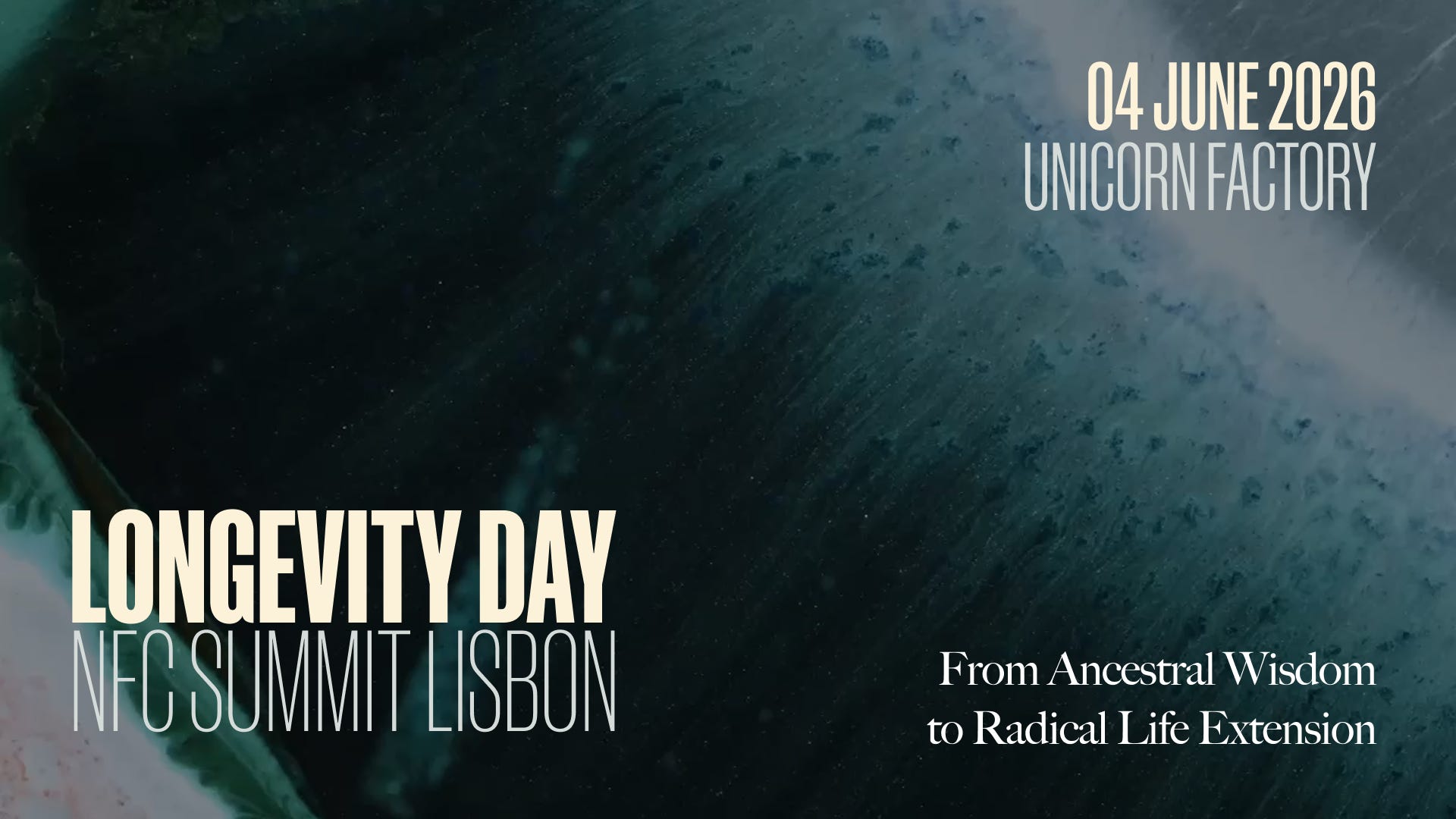
On June 4th. I’m curating a dedicated longevity stage inside NFC Summit. One of Europe’s largest Web3 and emerging tech conferences 2,000+ attendees from 59 countries!
Longevity Day is a full day of talks, panels, and conversations about where the science and the money are actually going. 26 speakers across longevity biotech, DeSci research infrastructure, and the companies building what comes next.
The theme is ‘From Ancestral Wisdom to Radical Life Extension’. We will cover three pillars: Past, Present, Future.
I have a discount code for the first 20 people to sign up! Use code: NINASNOTES20
Cheers,
Nina
💬 In this note:
⚠️ 40% of Women with PMDD have Suicidal Ideation
📚 Big Swiss
⚡️ The Egg Chooses
#183: ⚠️ 40% of Women With PMDD Have Suicidal Ideation

Last month was a very very stressful month for me.
I was dealing with two separate situations where I felt responsible for a lot of unhappy people. It was the kind of stress that gets under your skin, has you playing back decisions and conversations, and sticks with you for a while.
And somewhere in the thick of it, in the week before my period, I had a strange thought.
What if I just...disappeared? What would happen to all of this?
Not dramatic. Not scary at the moment.
More like my brain doing a weird stress calculation: if I remove me from the equation, what changes?
It passed quickly. And when my period came, those thoughts lifted completely.
I looked back on it afterward and thought: that was odd. Why did I think that?
So I started asking questions.
What’s Actually Happening In Your Brain During PMS
The week before your period is the late luteal phase. Progesterone and estrogen both start to decline as the body prepares for menstruation.
As women, we all know this…
What we don’t talk about is the cascade of neurochemical events happening in a woman’s brain, that most women have never been told about.
In the late luteal phase when progesterone drops, so does a metabolite called allopregnanolone (ALLO).
ALLO binds to GABA receptors in the brain. GABA is your main inhibitory neurotransmitter. Think of it as the brake pedal.
GABA prevents your nervous system from going into overdrive by blocking specific chemical messages, effectively slowing down brain activity to induce calmness, focus and sleep.
Therefore, you become more reactive, more sensitive to stress, and find it harder to regulate.
At the same time, falling estrogen reduces serotonin and dopamine activity, which are the neurotransmitters most closely associated with mood, happiness and motivation.
The prefrontal cortex, the region responsible for emotional regulation and rational decision-making, becomes less responsive during the luteal phase.
So to recap, in the late luteal phase, we lose the protections of estrogen, progesterone and GABA, which makes every emotion hit harder.
Other people’s moods can feel like your own. The interpersonal friction that you could easily brush off in the follicular phase, like their thoughts are theirs, not mine, now lands like a verdict.
The good news is that this is not a personality flaw.
This is pharmacology happening in your brain. Every. Single. Month.
And no one explains it to you. Until now.
The Thoughts No One Names
Most women know about PMS.
We’ve been told about the usual symptoms. You know, bloating, cramps, irritability, crying at ads for insurance.
What nobody told us, is that for some women, the luteal phase can also bring darker thoughts.
Intrusive ones.
The kind you don’t mention at dinner.
Things like: What if I weren’t here? What if I just stopped?
Not necessarily thoughts of self harm.
More like a morbid ‘what if…?’ that your brain serves up when it’s overwhelmed.
What I learned when I started diving into this is that there is a clinical spectrum in regards to these kinds of thoughts.
Clinicians distinguish between passive suicidal ideation (a wish to disappear or not exist, without intent to act), active ideation, and active planning with intent.
What I experienced, and what I suspect many women experience in the luteal phase under stress, sits somewhere in the gray area before and below the clinical threshold.
It’s not nothing.
And it’s not a crisis.
More like the mind reaching for extreme metaphors when it’s under heavy load.
For women that may experience these darker thoughts, it is possible they could have Premenstrual Dysphoric Disorder (PMDD), which is a severe, chronic form of PMS.
It causes debilitating emotional and physical symptoms during the two weeks before menstruation, which disappear shortly after a period begins.
PMDD is highly disruptive to daily life and requires targeted treatment.
For clarity, this experience is not a one time thing. This is something that happens monthly, for decades of a woman’s life.
And when I dug deeper I found out that researchers have actually looked at this. (T God!)
In a clinical sample of 110 women with confirmed PMDD, 39.1% reported suicidal ideation during the late luteal phase.
That’s nearly 40% of the women with PMDD experiencing suicidal ideation!!!
And no one is talking about it.
The silence problem isn’t the only stigma.
It’s that we’ve built a mental health vocabulary organized solely around crisis, and it skips over everything in the vast gray zone.
Women having these thoughts, can feel disturbed or ashamed, they may not even mention them to anyone.
And the worst part is that they may never learn that the menstrual timing is the cause.
PMS vs. PMDD: Where’s the Line?
PMDD affects around 5.5% of menstruating women.
And you may read that stat and think..oh 5.5% - that is not that bad.
*PAUSE*
Let me elaborate.
There are approximately 1.8 Billion menstruating women globally.
1.8 billion × 5.5% = ~99 million people with PMDD globally
Equalling roughly 100 million women.
100 MILLION!
That’s more than the entire population of the UK and France combined.
That’s more people than the population of Germany.
*picks jaw back up off the floor*
Despite that scale, no mainstream app tracks the darker symptom vocabulary!
And suicidality isn’t even in the diagnostic criteria yet.
grrrrr.
Anyway, what happens in the PMDD brain is fundamentally a neuroendocrinological condition, not a mood disorder in the traditional sense, but a sensitivity condition.
The body produces normal hormonal fluctuations, but the brain responds to them abnormally.
Research published in 2024 showed that people with PMDD don’t just have reduced ALLO during the luteal phase. They have altered sensitivity to ALLO itself.
In these women, normal allopregnanolone levels can paradoxically trigger anxiety and mood disturbances rather than calm. For them, the receptor is calibrated differently.
The key diagnostic signal for PMDD is that symptoms must lift in the follicular phase.
The stark contrast of feeling like a completely different person across the cycle, is not just anecdotal. It is actually the diagnostic data.
For years, many women with PMDD were misdiagnosed with bipolar disorder or borderline personality disorder because no one tracked the cyclical pattern.
Can you believe that?!? We are women, with cycling hormones and no one thought to check the menstrual cycle with symptoms!!!
The International Association for Premenstrual Disorders published a paper in 2025 arguing that suicidality should be formally investigated for inclusion in the PMDD diagnostic criteria, noting that major depressive disorder (MDD) and bipolar II already list it in the DSM-5.
I agree that clearer recognition could prevent exactly this kind of misdiagnosis. And it would help doctors and medical professionals recognize the seriousness of PMDD.
I’ve wondered recently if some of what I’ve experienced in particularly bad luteal phases might qualify as PMDD, or at least sits closer to it than I thought.
It’s possible, but as I thought this, I realized I’m someone who knows what PMDD is. I have a pharmacology background and even with that knowledge, I only learned PMDD existed as an adult.
No one told me when I might have most needed to know.
It Doesn’t Stop at Reproductive Age
…or should I say, and more bad news…
A 2025 review found that 84% of studies showed some association between the menopausal transition and increased suicidality.
One study found that perimenopausal women were seven times more likely to report suicidal thoughts compared to pre- or post-menopausal women.
Suicide rates among women aged 45–55 are notably elevated, which maps almost exactly onto the typical perimenopause window.
Perimenopause involves years of erratic estrogen swings before levels finally settle.
It is not a smooth descent.
And the women most affected are often those who already had significant luteal-phase symptoms earlier in their reproductive years. Which means perimenopause symptoms are a continuation of ones they may not have even known they had.
We talk about hot flashes.
We don’t talk about this.
The Tools Gap
I use Clue to track my cycle.
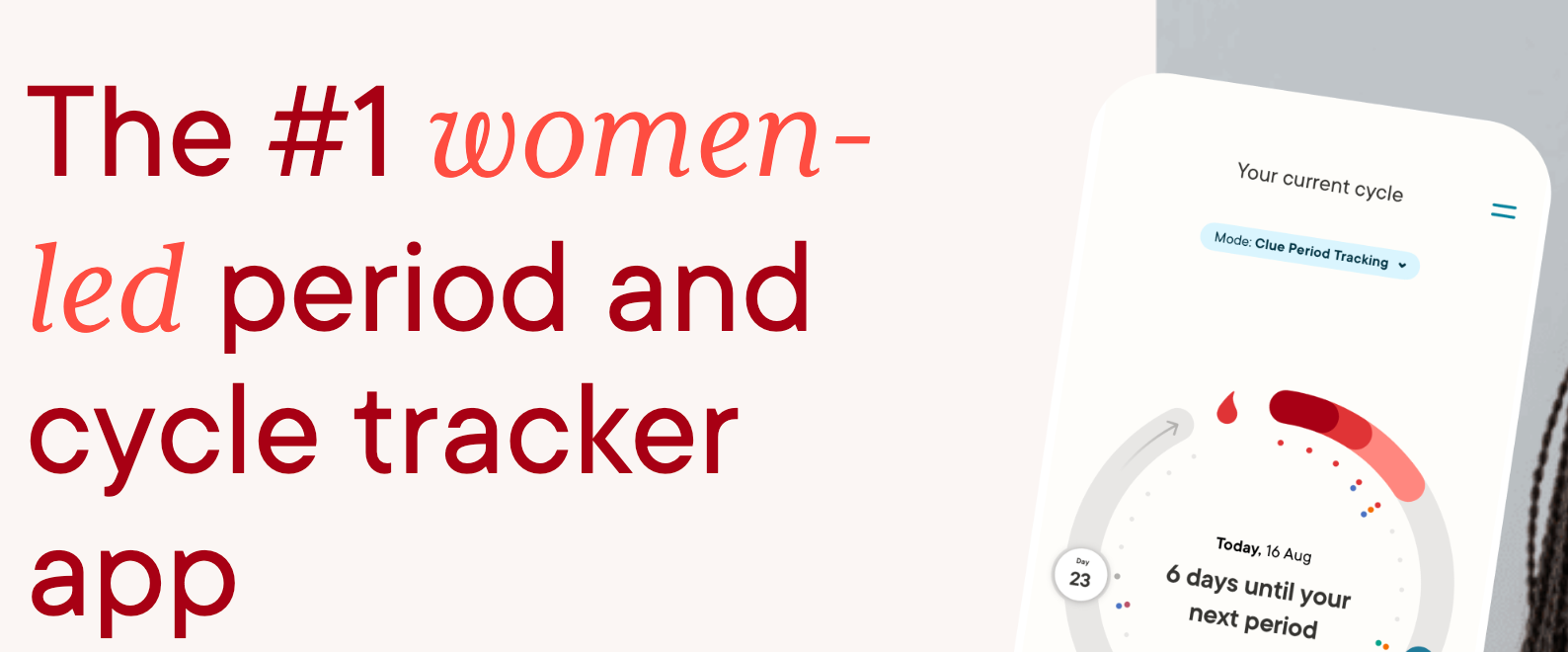
I like Clue because it has strong data protection. It’s a German company and the women behind it coined the term “FemTech”.
Overall, I’ve found it useful. But when I tried to think about logging something like “had a dark thought this week,” there’s no option for it.
There’s an option for “mood swings.”
There’s an option for “sad.”
There’s a redirect to an external resource if you select anything that sounds serious. That’s it.
They offer 13 emotions which cover a range of feelings, but it is definitely lacking.
And when you go to search for a feeling and it isn’t there, you don’t feel heard.
Clue App I love you! I really do…but reducing feelings to a group of just 13… downplays our emotions.
And women’s feelings are already downplayed 24/7.
I also found a study which confirmed what I suspected, that there is currently no menstrual and mood tracking app with the full capability to accurately capture PMDD symptoms to aid with diagnosis
There’s no normalized, non-alarming language for darker luteal experiences.
No way to log “felt like a burden today” or “I want to disappear” without it feeling like you’re flagging a serious crisis.
So women don’t log it. The pattern never becomes visible. The symptoms are never connected to the calendar.
The irony is that the research is ahead of the tools.
The IAPMD paper calling for suicidality to be included in PMDD diagnostic criteria was published in 2025
Meanwhile, the apps millions of women use to track their cycles still redirect you to a hotline rather than help you track a pattern.
Awareness is the Protection
When I had that dark thought last month, I was genuinely stressed.
But because I’m a scientist who’s a big nerd, I rigorously track my cycle.
And luckily for me, I thought I’m in the luteal phase. I’ve had a brutal few weeks. This is probably just my brain reaching for extreme scenarios because the chemical brake is off. It will pass.
And it did.
The knowledge that this is temporary, that there’s a pharmacological explanation, that it lifts, is itself protective.
This is not a replacement for treatment when treatment is needed.
But it can be a first layer of protection for the potentially millions of women who are in the normal-to-mild range and have no framework for what they’re experiencing.
Tracking your cycle, including the emotional and cognitive symptoms, along with the physical ones, can turn a confusing experience into a pattern.
Once you have a pattern, you can prepare for it. You can take steps and preventative measures with added awareness.
And eventually not feel ambushed by it.
Women deserve that framework.
We should have been given it years ago.
Does This Resonate?
I’ve never written about this before, partly because it’s personal territory and partly because I wasn’t sure how to frame it. I’m still not sure I’ve got it right.
But I think it’s one of the most underserved topics in women’s health, because the cultural permission to talk about it hasn’t been granted yet.
Quick Poll - Would love your answers 🙏🏽
📚 Book of the Week

Big Swiss by Jen Beagin
Rating: ★★★★★
Finally a 5 star book! I’ve been reading some mediocre books this year. Apologies dear readers, but now we have a clear 5 star, no excuses, brilliant read that had me cackling.
Big Swiss is hilarious, awkward, cringe and honest.
The story follows Greta, a transcriptionist for the local sex therapist, who goes by the name of Om, in the small town of Hudson.
Om’s newest client, who Greta knows from her initials FEW, captivates Greta with her traumatic past and sexual repression and she dubs her “Big Swiss”.
One day at the dog park, Greta recognizes Big Swiss’ voice and decides to approach.
Loaded with intimate details of Big Swiss’ life, while Big Swiss is completely unaware, the two become friends and lovers…and chaos ensues.
Pick this one up, you won’t regret it.
⚡️ Check This Out
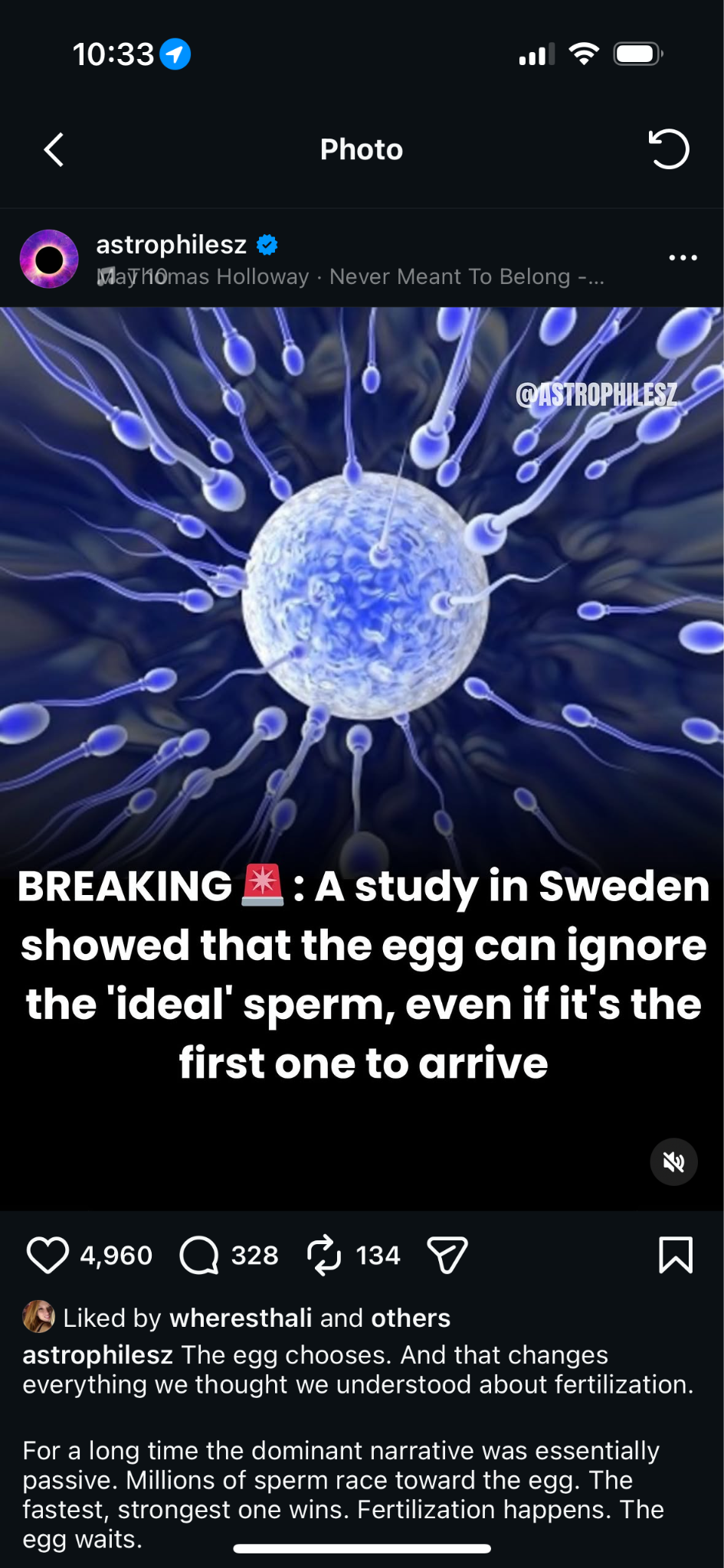
The egg chooses.
For centuries, the story of fertilization was framed as a race.
Millions of sperm, one winner, fastest takes all.
Turns out that’s…WRONG!
A study out of Stockholm University found that eggs actively release chemical signals, called chemoattractants, that don’t only attract sperm but also select which ones get through.
Different eggs release different signals.
Different signals attract different sperm.
The egg can even ignore the first sperm to arrive if the chemical compatibility isn’t right.
This study was published in 2020.
It’s now circulating Instagram like breaking news.
Which raises the real question, why did it take six years to go viral?
Why wasn’t this the headline everywhere the moment it was published?
We’ve had this information. We just weren’t talking about it.
Probably because the title of this paper, no offense to the authors, is “Chemical signals from eggs facilitate cryptic female choice in humans”.
Cryptic female choice in humans = what does that even mean!!??
Thank you to the journalists that extracted “the egg chooses” from “cryptic female choice” you’re doing the lords work 🫡
Human sexual reproduction builds an entire narrative around sperm…the speed, the competition, the conquest…making it all sound powerful, while female choice is “cryptic” and that the egg is passive in the process.
When it was the egg calling the shots the whole time!
The egg had the power and scientists just weren’t looking for it. That…in addition to the main article in today’s newsletter…is something worth sitting with.
🗣️ Looking for the Nina’s Notes Podcast?
You can also find the Nina’s Notes podcast on 🔴YouTube 🟢 Spotify, 🟣 Apple Podcasts, 🟠 Substack Podcasts where I interview entrepreneurs and have an archive of 100+ voiceovers of previous Nina’s Notes.
I also co-host Longevity.Technology UNLOCKED!
🎙️ Mondays: LT UNLOCKED interviews with leading longevity innovators, clinicians, and scientists
📰 Wednesdays: Nina’s Notes in your inbox with interviews, deep dives on longevity & neuroscience
🎙️ Fridays: LT UNLOCKED News, a weekly news roundup of the latest in longevity
Find Longevity Technology UNLOCKED on Spotify, Apple Podcasts, and YouTube.
Edited by Wright Time Publishing