


Hey friends,
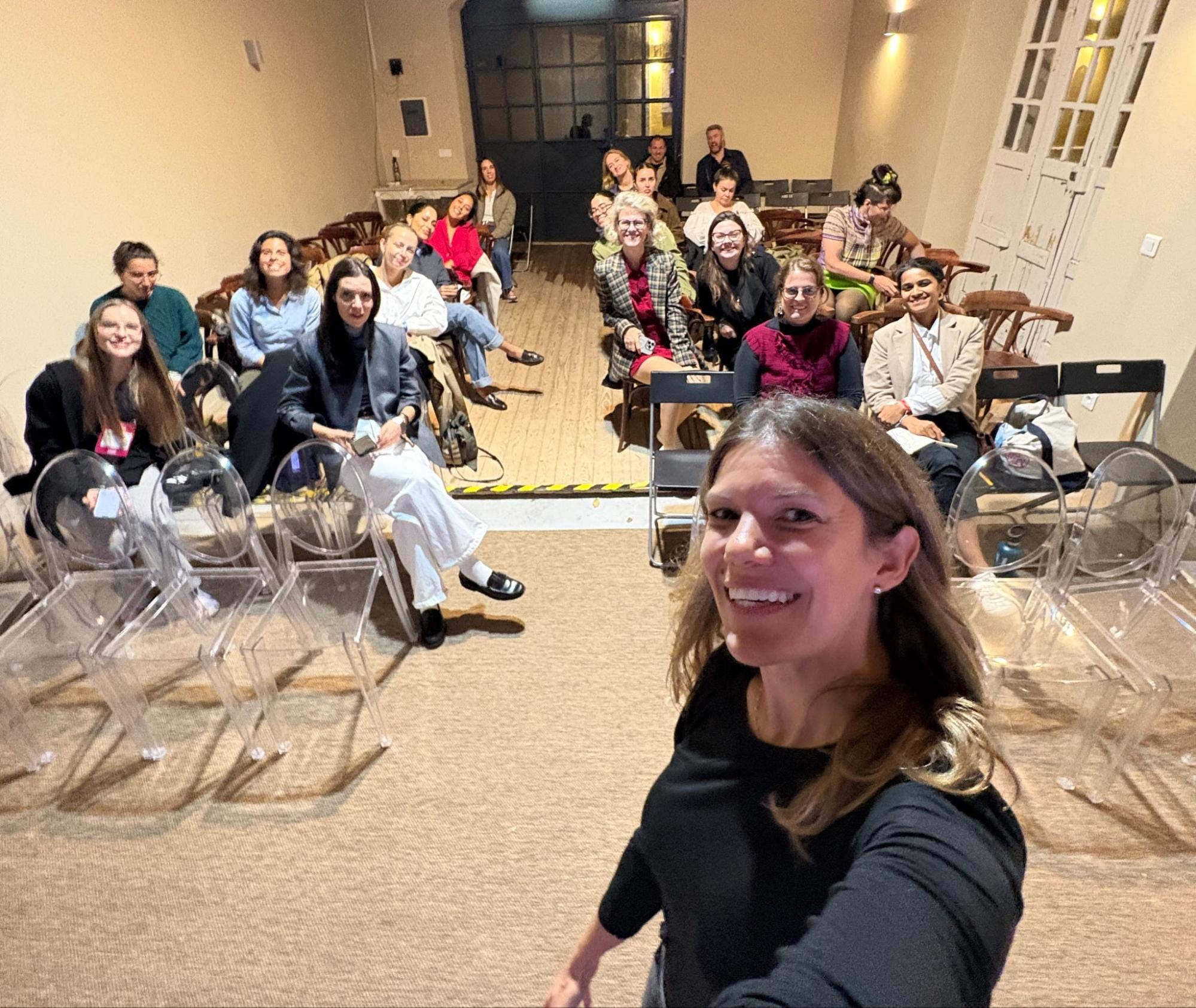
Last night I gave a talk at Portugal Tech Week, in a side room of a palace on top of a hill in Lisbon.
A storm was rolling in, half the city was cancelling things, and 156 women had signed up...so I was a little intimidated.
They came anyway (and a few brave men too).
If you're new here, hi!
I'm a PhD scientist. I've written this newsletter every week for 4 years, and I host the Nina's Notes podcast.
In March I took one Claude Code class, and I was hooked. I spent the next weeks all day, every day, building with Claude Code.
I was writing my own scripts and programs...and I couldn't stop.
The funny thing is, the only people I was talking to about it were my male friends.
So I asked my girlfriends if they were doing anything with it, and they said, "I don't know...but can you teach us?"
I said, "Sure, come over to my living room."
That first class was 3 women. 16 weeks later, I've taught 90 Ladies Who Claude, and I started it because I don't want to gatekeep this.
At the end of the talk I told the room that tomorrow's newsletter would be this presentation, in text form.
So here it is.
Cheers,
Nina
#207: 🤖 How AI Tools Are Changing the Way Women Do Business
64% of women say they never use AI at work.
Only 9% use it multiple times a day. For men, it's 14%.
Across studies, the gender gap in AI adoption is about 25%.
When I put that slide up, I said it out loud: this is shocking.
Like, that's insane that 64% of women are not using AI at work.
Me? on the other hand….
I use AI every minute of every day.
It's running things for me when I'm not even at my computer.
Here's why that gap matters more than it looks.
The roles most exposed to AI are the roles women hold.
Admin, marketing, communications, finance.
The work is still there. It just gets faster.
Which means the women who learn to move faster with it become even more irreplaceable.
Every woman in that room was smart enough for this.
Most of them just never had someone sit down and show them how.
And that part is fixable in one afternoon.
Start here. 👇
These are the 12 things I told the room, in the order I told them.
Before you start, make sure you send this to one woman who'd use it. It's free, and it's how this grows.
1. You just hired an intern.
This is the picture I want in your head before anything else.
Claude is a very eager 22-year-old who works around the clock, never gets tired, never gets offended, and costs about $20 a month.
The cheapest intern of all time.
Your job is to brief them well.
My real-life intern, Andrea, is also 22.
Sometimes she forgets where my files are. "Nina, I don't know where that is."
And I'm like, "You remember...it's in the Ladies Who Claude folder, in carousels."
Claude does the exact same thing. "I don't know where that file is."
And I tell Claude… "You know where the file is."
So when it gets something wrong, give it feedback and go again, the way you would with a real intern. (You can even get a little snarky with it.)
What I see over and over is women getting one vague, generic answer and deciding the tool isn't for them.
You wouldn't fire a new intern on day one.
Don't fire this one either.
2. Most people are stuck on level 0.
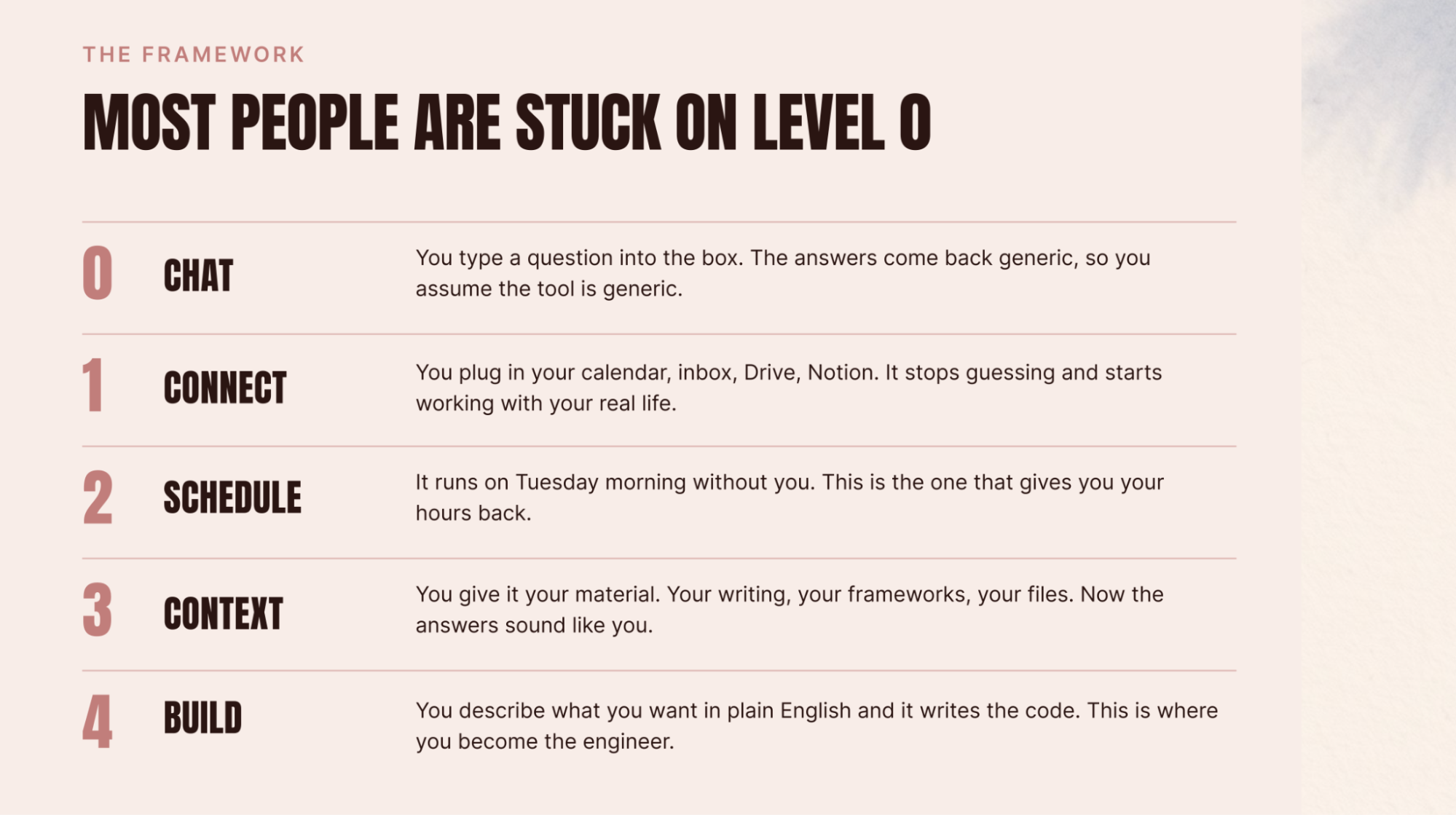
There are 5 levels to using AI, and most people never leave the first one:
Level 0: Chat. You type a question into the box and get an answer back. Thought partner, sparring partner...this is how most of the women I meet use it. Sadly, it's level 0.
Level 1: Connect. You plug in your email, calendar, Drive, Stripe, Notion. It stops guessing and starts working with your real life.
Level 2: Schedule. It runs on Tuesday morning without you. This is the one that gives you your hours back.
Level 3: Context. You give it your material. Your writing, your frameworks, your files, your voice. Now the answers sound like you.
Level 4: Build. You describe what you want in plain English and it writes the code. This is my favorite, and it's what I teach. This is where all of us become engineers.
Here's how small that last group really is.
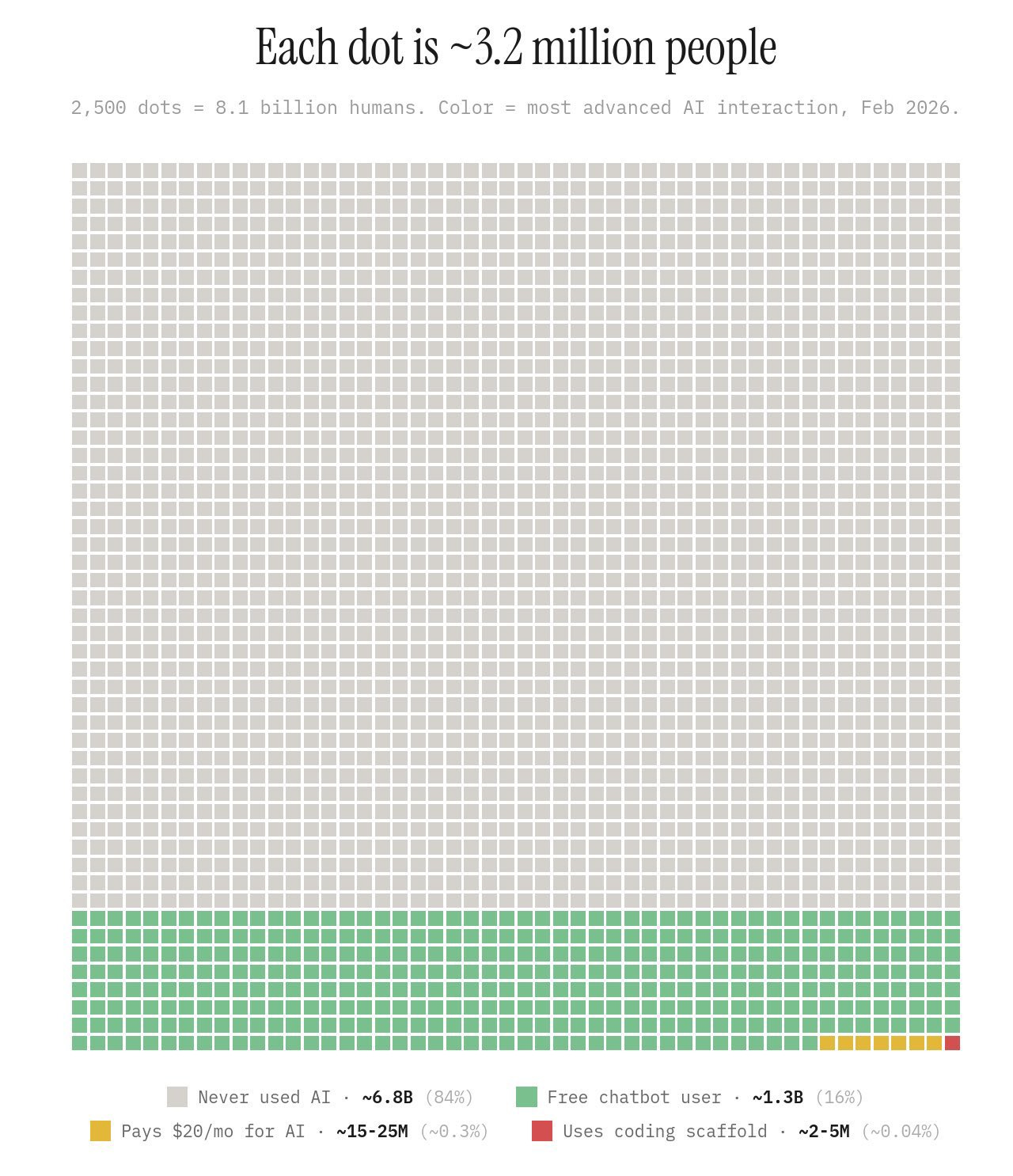
There are 8 billion people in the world.
About 1 billion use a free AI chatbot. (Green squares)
Somewhere between 15 and 25 million pay $20 a month for it. (Yellow squares)
Only 2 to 5 million use the coding features. (That single red square in the bottom right corner)
That's about 0.04% of the world.
So if you learn to write code with AI, you're in the top - less than 1% - of AI users.
And it is not that complicated to learn.
3. Claude speaks the language of the computer.
For decades, software engineers were valuable because they were the only ones who could talk to the machine.
They went to university for 4 years to learn Python, C++, Ruby, HTML, whatever the hell language they needed.
Now Claude speaks the language of the computer, and you speak to Claude.
I have a PhD in pharmaceutical science. Completely different field.
And now I speak Python...and I never had to learn it.
Women who were locked out of coding because they thought they were "non-technical"... guess what ladies, you are not locked out anymore.
If you can say what you want in your own language, you're technical now.
This is the most levelling thing I have seen in my career.
4. Anyone who can dream it can build it.
Until now, software was built by people who could write code, and people with the money to hire them.
So we got the products they wanted.
Now I can talk to Claude for $20 a month and it builds me software.
So I showed them, live in the room yesterday.
I opened Claude in my terminal (because it makes me look more like a software developer) and asked the room for a game they played as a kid.
Someone shouted, "Snake!"
So I talked to Claude.
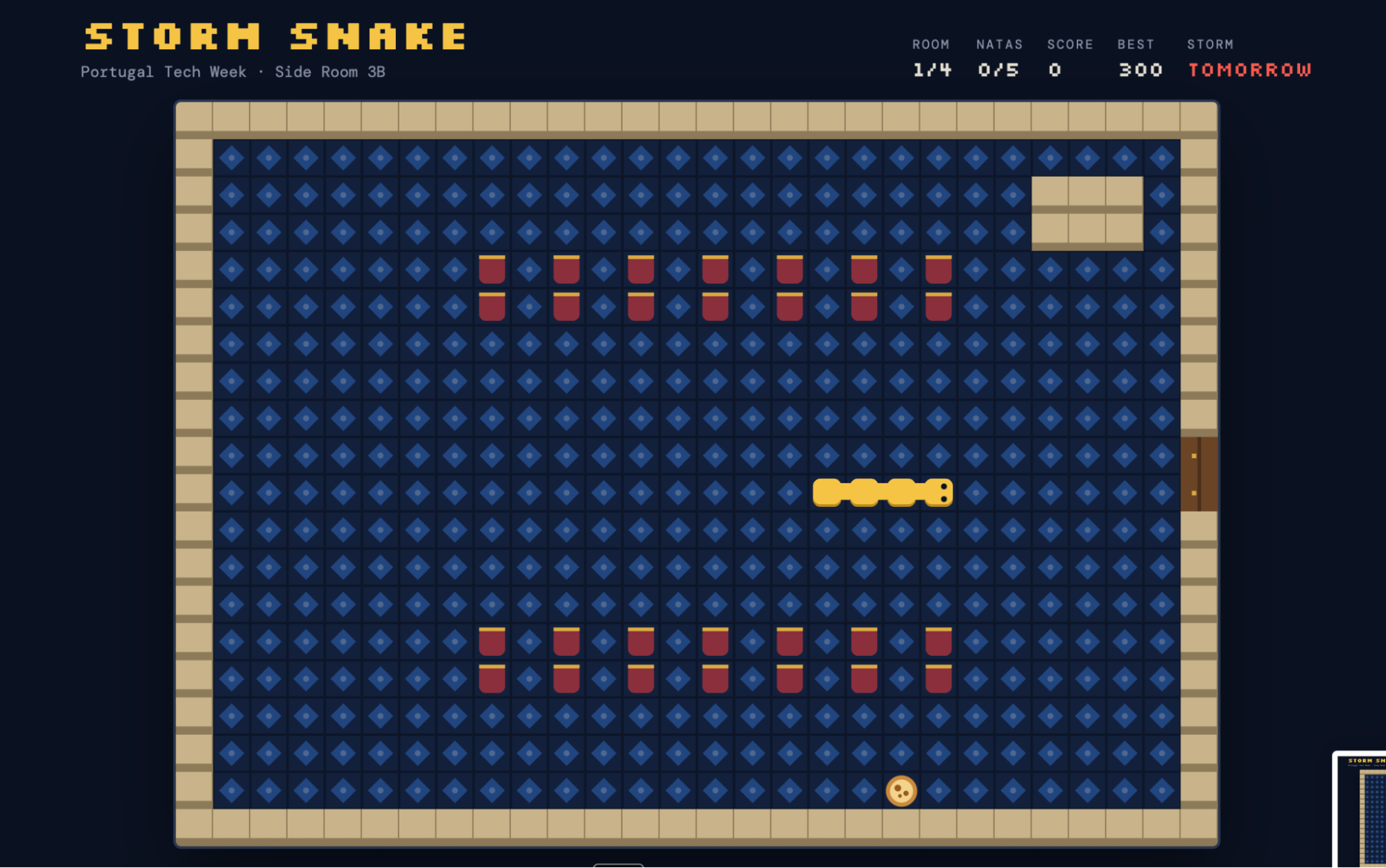
I said something similar to: "I want to build a Snake game like the old Nokia one. We're at Portugal Tech Week, in a side room of a palace, so maybe the snake has to escape into the main room. We're on top of a hill in Lisbon, and a storm is coming tomorrow that's shut everything down. Work that in. Make it fast, make it fun, make it playable in the browser."
Then I sent it off and carried on with the talk.
A few minutes later, mid-sentence...a game popped up.
The game: you're a snake at a tech conference in a palace on a hill, a storm is coming, the event just got shut down, and you have to get out of the side room, through the palace, and onto the last tram down the hill.
Built in 5 minutes and 42 seconds.
I did not write one line of code.
(I was also very bad at playing it live.)
Want to try? Play it here.
It's a silly example, I know.
But your wheels start turning. "Oh...I could put a quiz on my website so new customers can assess where they are."
Before, you didn't know how to do that. Now you ask Claude to build it and put it on your site.
I think that means a surge of more particular, more tailored products...and a lot more products made for women, by women.
Let's make sure women are part of this next wave.
5. The gap is smallest right now.
Right now, the distance between what you know and what you don't know about AI is small.
If you only use the chatbot and you want to get to level 4, it's about 3 hours of handholding.
That's it.
But that gap is going to get bigger. Some people are rejecting AI, some are scared of it, and the people using it are pulling ahead.
One day it will close again, when AI is so built into everything that nobody needs to know the difference.
But the people who understand what's happening in the background will have more power.
The cheapest moment to close your gap is today, while it's still 3 hours wide.
Every Wednesday at 5pm GMT, 12pm Eastern, 9am Pacific I get on live and show paid subscribers what I'm building with AI. Upgrade here.
6. Here’s my proof.
This is what Claude actually did to my business:
→ 3 hours. I had the idea for Ladies Who Claude, bought the domain, built the website, hooked up my Stripe links...and had my first paying customer, all in 3 hours. On WordPress (dear God, WordPress) that would have taken me a week and a developer.
→ 4 years. I pointed Claude Code at 4 years of this newsletter, 206 issues. Now I ask "when did I write about that supplement?" and get the answer. It even tells me which guidebooks I should make.
→ 90 minutes, 5 sales. I made one of those guidebooks in about 90 minutes. Designed it, put it on my website, sent it to my list...and had 5 sales before I got to happy hour. My designer would have needed 2 weeks.
→ 90 minutes to 10 minutes. My weekly news script meant reading 60 articles, picking 3, and writing them up. It took 90 minutes to 2 hours every week and I hated it so much I truly wanted to quit the podcast. Now it lands in my inbox and I edit it for 10.
→ 39 YouTube videos, 2 days. New titles, descriptions and tags for my back catalogue, pushed live from one table. (I didn't even know what tags were. Claude told me.)
The one that matters most to me is the news script. I hated that task. Claude helped get it done with 0 involvement from me.
7. My main stack is six tools.
That's the whole list:
→ Claude Code. My favorite. I don't start tasks anymore. I tell Claude what I want, give it a goal, and watch it work.
→ Codex. Same same but different. When I run out of tokens in Claude (sorry, Claude), I go over there and pick up exactly where I left off.
→ Wispr Flow. I talk instead of type.
→ Granola. Sits in my meetings and takes the notes.
→ Higgsfield. Images and video on demand.
→ Figma. Where the brand lives.
If someone asks me Claude Code or Codex?
Either. Pick one, and start.
8. I talk. It types.
Wispr Flow turns speech into text in any text box you click on. Claude, WhatsApp, email, your phone.
That Storm Snake prompt? I said it out loud with Wispr Flow.
I would never have given Claude that much detail if I'd been typing it.
I speak at about 180 words per minute. I type at about 80.
That alone saves me about 5 hours a week.
Remember when AI came out and everyone was selling these giant prompts? I looked at them and thought, "Oh my God, I'm never going to be able to write that."
You don't have to.
Say what you want out loud, with all the details, and let Claude clean it up.
If you take one thing from this whole newsletter, download Wispr Flow. I don't work for them (unfortunately).
💡 Pro tip: start with Wispr Flow, before any AI at all. It's the tool I'd hand a beginner first. Nothing to learn, nothing to set up beyond the download. You just start talking to your computer, and the next step (talking to Claude) feels a lot less scary.
9. Granola is my memory.
I stopped taking notes in meetings.
Now I pay attention to the person instead of my notepad.
Granola writes it all down, so every class, sales call and coaching session becomes searchable text.
And there's a little chat box at the bottom where you can ask the meeting a question, live.
Here's how I’ve used that.
I went to science school, not business school. My sales calls weren't landing.
So mid-call, I would literally type, "How do I close this deal?" And it would read the transcript so far and give me ideas.
(Spoiler: that alone didn't fix my sales. Lesson 14 did. It's below the paywall.)
Then overnight, Claude turns those notes into CRM rows, follow-ups and content.
One honest flaw: Granola doesn't tell anyone it's recording. So before the talk I asked the room if it was ok to record. Please do the same.
And honestly, assume you're always being recorded now.
10. Images and video, no designer.
Higgsfield puts all the image and video models in one place, so I have thumbnails, reels and teasers without hiring a designer or booking a shoot.
→ A teaser trailer for a guidebook, from idea to finished file in 14 minutes, with Claude writing the outline and the prompts. I added my own voiceover. A designer would have taken weeks and charged me €1,000 to €2,000.
→ A 45-page desert-themed adult coloring book. Not published yet, but it's coming.
→ Every YouTube thumbnail comes from the same prompt recipe, so the channel looks like a set.
One tip: image generators are still bad at text. Words come out misspelled or funky. So I make the image in Higgsfield and put the text on in Figma.
None of these were things I could do before. They were things I paid for. Now I can do it myself in minutes.
11. Figma is where the brand lives.
My colors, fonts and layout rules live in one file that a person and an AI can both open.
Claude reads a frame and builds the page from it, so I've stopped trying to describe a design in words.
The slides for this talk were built that way. I described what I wanted out loud, and Claude built them straight into the deck.
They don't look like typical AI design, because it's learned my brand.
One honest limit: it can't use my licensed brand fonts, only Google fonts. So anything built this way gets designed in stand-in fonts and swapped over at the end. A bit of a pain...I'm sure they'll fix it.
Worth knowing before you promise a client a finished file.
12. Every good brief answers four questions.
Back to your AI intern you just hired. Here's how to brief them.
This was the last slide, and the one everyone took a photo of.
Copy this, and fill in the brackets:
Who I am and who this is for: [your business, your reader, and why this matters today]
What I want: [one clear job]
What good looks like: [paste a finished example of your own and say "like this"]
What it must not do: [length, tone, any phrases you never want to see in your name]
Here's how I'd use it. "I'm Nina, founder of Ladies Who Claude, and I'm preparing a proposal for a Claude workshop. I want an 8-slide deck. Use the proposal we made last week as the template, I was really happy with it. Don't go over 8 slides, write it in my voice, and no em dashes."
Number 3 is the one everyone misses.
Show it what good looks like, and it will be good.
One clear job per prompt works better than three tangled ones.
This newsletter grows because people like you share it.
The questions after
My favorite part of any talk is the Q&A. This room did not hold back.
Women who use AI are judged harder for it
One woman said she pushes lots of AI code at his startup, and sometimes her co-founder looks at it and says, "This has 2,000 lines. I can do it in 300."
That reminded me of a study I think every woman using AI should know about.
In a study of 1,026 engineers, people rated the exact same code.
When they were told a woman used AI to write it, they rated her 13% less competent.
When a man used AI, 6%.
And men who don't use AI themselves rated women who do, 26% less competent.
Source: Acar, Gai, Tu and Hou, "The Hidden Penalty of Using AI at Work," Harvard Business Review, August 2025, as reported by LeadDev, August 2025.
Same code, same quality. The only thing that changed was knowing she used AI.
That was really hard to sit with.
So my practical advice was: know it's there. Ask Claude to clean up your code, take it one more step before you show it.
But I think it's also exactly why we learn this together, in rooms like that one, and get good enough that the work speaks for itself.
"What about AI slop?"
I hate AI writing so much. I don't want to read books written by AI.
I still write this newsletter myself.
You read it because you want to hear what I think.
Nobody wants to read something regurgitated out of ChatGPT.
What AI does is put it on Substack for me.
That used to be a job I paid for, and now my employees get to do something more useful.
Use it to take the admin off your plate.
Keep the thinking as still yours.
"What about the environmental cost?"
This was the hardest question of the night, and a really good one.
A woman asked how I square it. I wouldn't pay a person $300 a month to work for me 24/7...so why is it ok to do that with a machine that uses electricity and water?
Honest answer: I don't have a perfect one.
I have one account. When I run out of tokens for the day, I stop and take a break. (I have friends with 6 accounts who just keep switching. I'm not that person.)
And if Anthropic, or anyone, showed me how many rivers my token usage was draining, I'd want to offset it.
Someone should build that. Maybe one of you.
"So what do you do with the time?"
Then she asked the question I loved most.
What do I actually do with all the time AI gives back?
I make ceramics.
I write. I go to real-life events. I spend time with people.
I'm an insane optimist, so I think handmade things are going to become a lot more valuable.
I want to read books by humans and hold ceramics made by a human.
That's why I want AI to take every repetitive task off my hands.
So I can go do more of that.
Every Wednesday at 5pm GMT, 12pm Eastern, 9am Pacific I get on live and show paid subscribers what I'm building with AI. Upgrade here.
How to start
If you're reading this, you're early.
Here’s what to do:
→ Treat Claude like an intern, and brief it like one.
→ Climb one level this week. If you only chat, connect your calendar or inbox.
→ Download Wispr Flow and talk instead of type.
→ Write your next prompt with the 4 questions.
→ If you build something for other people, give it to 10 of them first. If they're still using it after 30 days, you have something. (Just because you build it doesn't mean they will come. I learned that the hard way.)
I spend most of my day in Claude now. Writing, building, running two businesses.
You pay Claude about $20 a month.
But you probably use a small part of it.
Mostly because nobody sat down and showed you how.
I'm not paid by Anthropic. So I only show you what I actually use (and what still annoys me).
Here's what paid subscribers get:
Build Hour, live every Wednesday at 5pm GMT (12pm Eastern / 9am Pacific). I share my screen and show you what I built that week, how I did it, and what broke. You bring questions. It's recorded in case you miss it.
The exact prompts behind the 3 workflows I shared last night during my talk, including how to make Claude your Sales Coach (they're right below the paywall in this issue).
Access to my paid subscriber chat on Substack
All of it is in the paid subscription: $200 a year, or $20 a month.
Less than $1 a day.
Upgrade today and save your seat for today’s Build Hour.
The link to this week's Build Hour is below, for paid subscribers...
P.S. If last night's talk was where you found me, the next round of my 30-day challenge, Master Claude Code for Business Women, starts November 16. Doors close November 13. Everything is at ladieswhoclaude.com.
In that room last night, I showed 3 more things.
The exact prompts are after the paywall, starting with the one that tells me every morning what to hand off.