


Hey Friends,
I’m teaching an AI for Everyday Work workshop on Sunday at 10am Pacific, 1pm Eastern, 7pm Central Europe for my Ladies Who Claude. It’s live online and you’ll get the recorded class if you can’t make it!
This will be the only online workshop for beginners I will run for the rest of the year.
Recently I’ve been seeing AI drug discovery companies one after another announcing big VC fundraisers.
So far, in 2026 alone, $8.64B has been poured into AI drug discovery companies.
And I get it.
It’s an attractive bet.
If we can make more molecules, and get better at modeling the binding of those molecules to targets, then we have more chances to find interesting pharmaceutical drugs.
Right? Seems straightforward.
Investors love a straightforward, convincing story.
But…the truth to this is far more complex.
Where these companies are focusing is at a nano-fraction of the entire drug development pipeline, the discovery phase.
The discovery phase includes the identification or creation of a therapeutic that might be able to address the symptoms or underlying cause of a disease.
This is the first step to the 10+ year process to take a drug from discovery to patients.
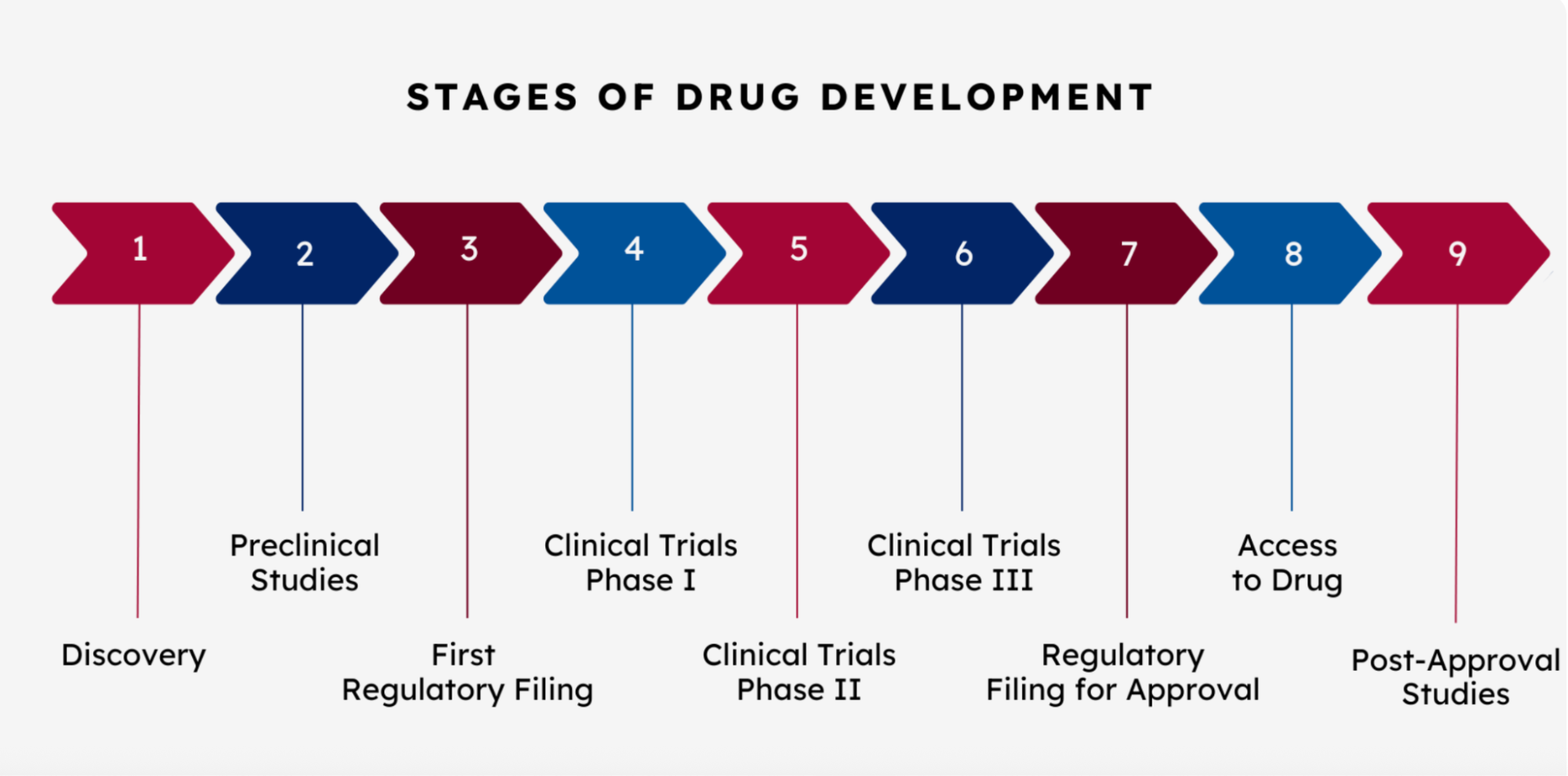
The discovery phase has a very dismal success rate.
For every 20,000-30,000 compounds tested in this first step, only one is eventually approved.
Because of this insanely high failure rate, many of these AI drug discovery companies are solely focusing on the design step.
Like I said in the beginning…if we can design more molecules, we have more options and higher chances of success, right?
Well that’s what Isomorphic Labs believes, and they made headlines this year securing $2.1 Billion to scale its AI drug design engine.
And when you dig into the top funded AI companies, many are focusing on the same problem.
The problem of expanding the chemical space.
Now the reason that this frustrates me is that synthetic chemists have been doing this for decades. Just…not yet with AI.
It has been calculated that there are 10⁶⁰ possible drug-like molecules. This number is roughly equal to the number of atoms in the entire Milky Way Galaxy.
This figure was sketched on the back of an envelope by computational chemists back in 1996.
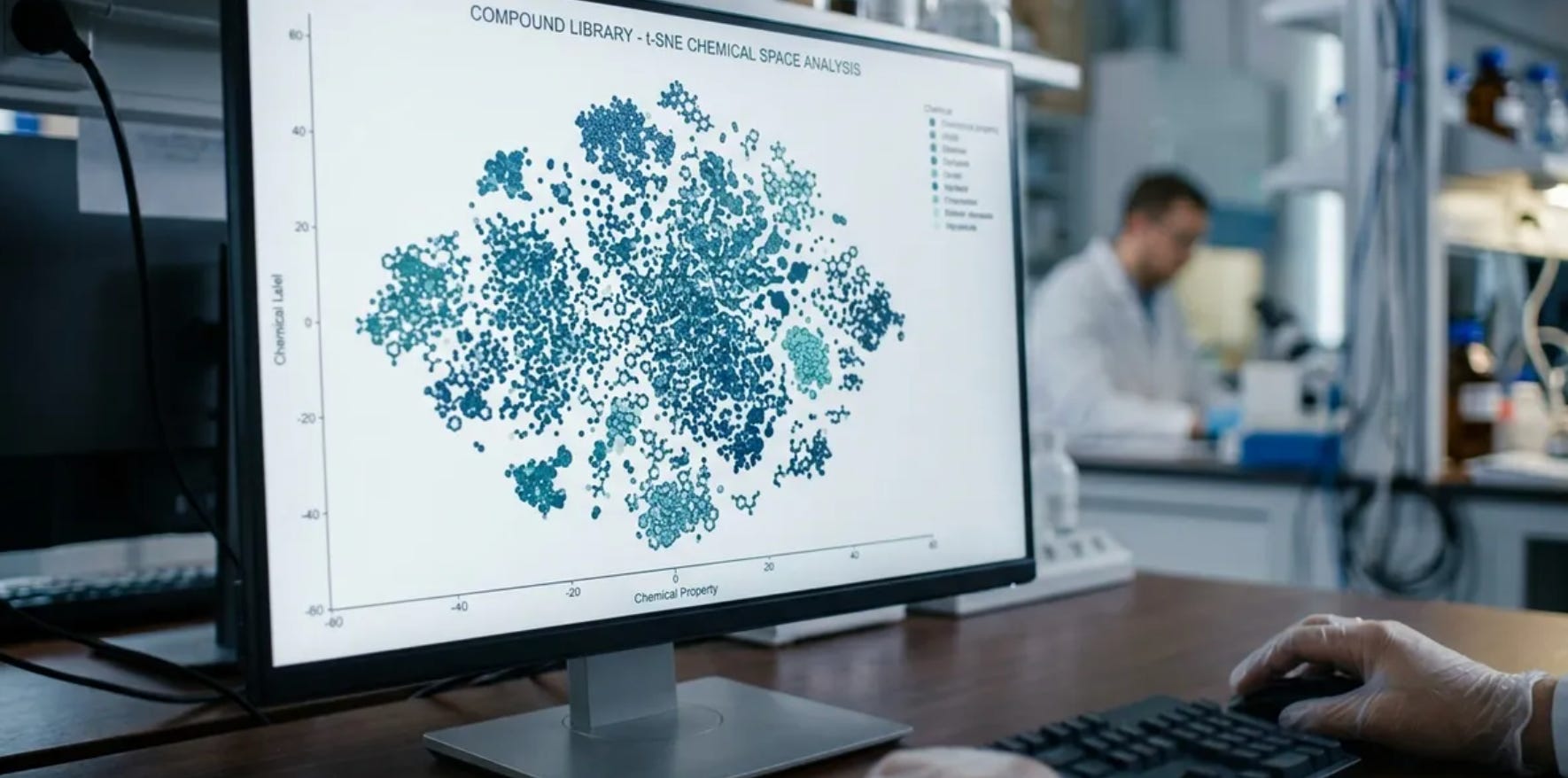
“Drug-like” molecules mean small-molecules that follow a set of rules that allow for a high likelihood of bioavailability which indicates whether a chemical compound can be absorbed effectively when taken orally.
Of those 10⁶⁰ possible drug-like molecules, it is believed that we have chemically synthesized 10⁸ or roughly 0.1% of small-molecule chemical space.
And honestly, 0.1% is a generous percentage. I rounded up for simplicity.
If you actually write it out in full decimal form it looks like:
0.00000000000000000000000000000000000000000000000001%
So…there is a LOT left to discover.
Which explains why technologies like generative AI is such an attractive investment, because traditional methods barely scratch the surface of what is chemically possible.
However to increase the chemical space comes with a lot of challenges.
Challenge #1: Blind Spots
The chemical space is so vast that any physical or virtual library we could create would be too small to hold it all.
Searching for these new chemicals can feel like looking for a needle in a haystack, or a drop in an ocean.
And because of this, there can be huge blind spots in our search.
We cannot infer the drug properties of the whole chemical space through such a tiny sample.
Challenge #2: Searching the Chemical Space
Drug-like molecules are very complex, with each one you have to track hundreds of chemical properties (molecular weight, solubility, toxicity, synthetic accessibility, etc.), another word for these molecules is high-dimensional.
Standard search algorithms break down in high-dimensional spaces.
In those environments the volume of chemical space grows exponentially, making it difficult for traditional software to find a molecule that ticks all the boxes.
Challenge #3: Chemical Synthesis
Now, let’s talk about bringing a virtual chemical designed with generative AI into reality.
Just because a machine learning algorithm can mathematically construct a molecule does not mean that a human or robot can chemically synthesize it.
When I was in grad school, the first lab I rotated with was a synthetic chemistry lab. Our entire goal was to expand the chemical space by synthesizing molecules by hand.
We would design a batch of molecules and then one-by-one try to synthetize them.
We’d use established chemical reactions to transform simple starting materials into the more complex drug-like compounds we were aiming for.
Specifically, I was using an established chemical synthesis process called the “Ugi reaction” named after the chemist who discovered it.
It is a multi-component reaction (MCR for short). MRCs use three or more starting materials to react in a single vessel, called “one-pot” reactions.
Imagine this like you are baking a cake, you put 3 or more ingredients together into a baking pan…heat and viola, you have a cake. Chemistry is similar.
At the end of an MCR you get a highly structured final product containing all the parts of the components.
This is attractive because the chemical reaction is highly modular, which can lead to a lot of chemical diversity. For example, if you have 4 different components, and 10 variations of each component, you can potentially synthesize a chemical library of 10,000 different compounds.
However, in reality…It didn’t always work that way.
If one reaction didn’t work, I wouldn’t spend too much time troubleshooting it because I had 9,999 more chemicals to synthesize instead.
So I spent a semester running endless Ugi reactions to make a chemical library of benzodiazepines, all to send to the NIH for them to put on a shelf to use for future screening.
It was so boring that I left that lab to study something else. It was definitely work that a robot could try to do instead of a human!