


Hey friends,
A few weeks ago, I drove out to a festival at a resort in Mafra, about thirty minutes from Lisbon, to try the Neera bed topper.
It is a mattress with speakers built into it, but instead of playing sound into your ears, it plays very low frequencies through the whole surface of the bed, into your body.
I left the experience relaxed, calm and like I had taken a much longer nap.
I was curious to find out why a vibrating bed can result in blissful experiences, falling asleep faster and more restorative sleep.
So I sat down with Igor, one of Neera's cofounders, for a podcast about Neera, and then I went down the research rabbit hole.
Here’s what I learned.
Nina
💬 In this note:
🔊 The Science of Sound, Vibration and Deep Sleep
📚 The Calamity Club
⚡️ Master Claude in 30-days
#198: 🔊 The Science of Sound, Vibration and Deep Sleep
Millions of neurons are firing together in your brain all of the time, even in the deepest sleep.
The neurons fire together in rhythmic waves that we can measure by EEG, where we measure the speed in hertz (Hz) or speed per second.
These waves can then be simplified into frequency bands, which associate with a rough state of mind:
Delta (roughly 0.5 to 4 Hz) is the slowest and largest wave. This is deep, dreamless, non-REM sleep. The more delta you have, the less aware you are of the world around you.
Theta (4 to 8 Hz) is the drowsy in-between state, the drifting feeling right before you fall asleep, and it also shows up in meditation and daydreaming.
Alpha (8 to 12 Hz) is relaxed wakefulness. Think eyes closed, calm, but awake. Alpha is what fades when you actually fall asleep.
Beta (13 to 30 Hz) is alert, focused, task-oriented thinking (and also worry and rumination, which is why it is not what you want at 2AM).
Gamma (above 30 Hz, often centered around 40 Hz) shows up when the brain needs to bind information from many regions at once, and it has become a hot research topic for reasons I will get to below.
Two of those numbers matter most for this story today.
The first is 1 Hz and below, the frequency of deep sleep.
The second is 0.25 Hz, which is even slower than any brain wave, and which turns out to be the magic number for rocking.
Why Rocking Works
Every parent knows a baby falls asleep in a moving car, and every commuter has nodded off on a train. That gentle, rhythmic motion makes us sleepy.
What we have not known, until quite recently, is what it does inside the brain.
In 2011, a team of researchers at the University of Geneva built a bed that could either remain stationary, or rock gently at 0.25 Hz, which is one full rock every four seconds.
Illustrated elegantly in Figure 1A from their 2011 paper in Cell below. (cute)
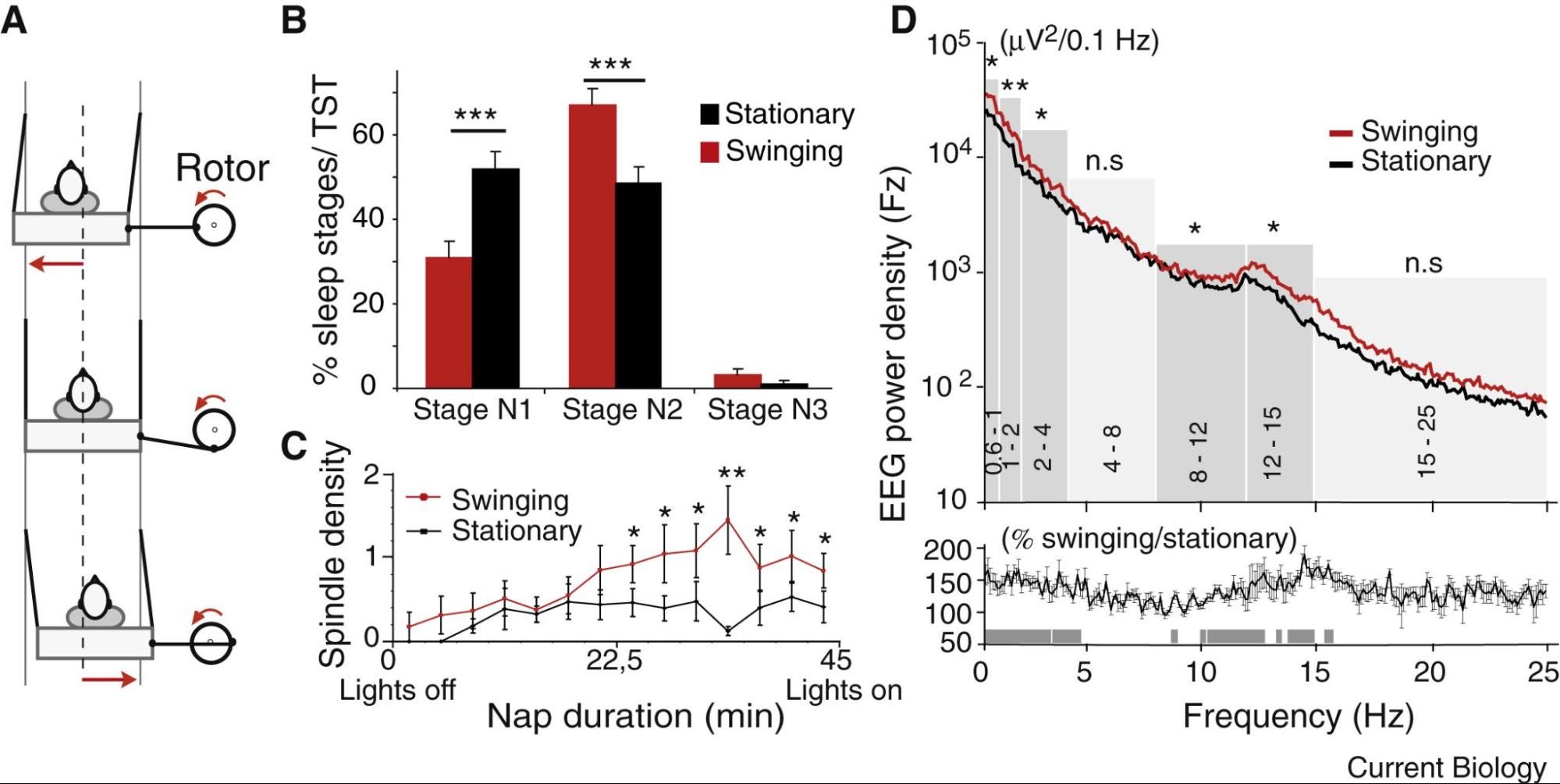
The researchers asked people to nap on the bed, and compared to the bed when it was stationary.
Participants in the study fell asleep faster, spent more time in N2 sleep (non-REM sleep), and their EEG showed a boost in slow oscillations that mark stable, protected sleep.
The authors' explanation was that the swinging motion "exerts a synchronizing action in the brain that reinforces endogenous sleep rhythms." In plain words, the bed was nudging the brain's own sleep rhythm along.
But how?
Paul Franken's lab at the University of Lausanne, answered this question in mice in 2019.
His team showed that rocking put mice to sleep faster and kept them asleep longer.
This only happened if their otolith organs, the tiny sensory structures in the inner ear that sense gravity, head tilt, and straight-line motion, were intact and functioning properly.
Mice without a working inner ear sensory system got nothing from the rocking.
That means that the pathway that rocking and/or vibration reaches the brain, is through the inner ear, into the brainstem, and up into the circuits that time sleep.
Fun fact: The mice liked 1 Hz best, while humans liked 0.25 Hz. Mice have a faster heartbeat than humans (nearly 10x faster), so the faster rocking fits their much faster natural rhythms.
What Neera Actually Does
While it would be cool to have a giant rocking bed at home, it’s just not practical. (le sigh).
Neera Sleep is much more subtle, and something that would actually fit in your bedroom.
Inside the mattress is a sandwich of actuators, the same components that make a speaker cone move, enclosed in a waveguide that spreads the vibration across the whole surface of the bed.
Neera founder, Igor Me, told me in our podcast interview that the design goal was a sound that "shouldn't sound as a sound."
In my experience, you do not hear it so much as feel it, as if the vibration is a field you are floating in.
When I asked him how they chose the frequencies that the bed plays (for lack of a better word).
He said that the starting point was the same as this article's.
That our brain has frequency signatures in each stage of sleep, from alpha down through theta and delta.
In designing Neera Igor’s hypothesis was that if you could deliver those frequencies through the skin, you could help the body reach those states faster.
His reasoning is that we have far more mechanoreceptors (the pressure and vibration sensors in our skin, muscle and bone) than we have auditory receptors, and the mechanoreceptors feed straight into the primal, ancient, older parts of the brain without passing through the consciousness.
However, achieving those frequencies in a bed is an engineering challenge.
So what Neera does, which is very clever, is that it generates two much higher frequencies that are very close together and the interference between them produces a slow "beat" at the difference between them, which the body feels as a 2, 3 or 4 Hz pulse.
Igor's example was 20,000 Hz played against 20,002 Hz….resulting in a 2 Hz pulse.
He also told me it took a lot of algorithmic tuning to get a consistent effect across different bodies.
Essentially, your response and my response to the same frequency are not the same (which was a big surprise to me too).
The session I did was the daytime program, which is not designed to be below your perception.
You can very much feel the vibrations across your whole body.
It ran in three parts: a lymphatic drainage segment, then a non-sleep deep rest segment where the frequencies move down through the body, then a ramp back up toward alertness so you do not walk out groggy.
For me, it took me a while to drop into a meditative state, and once I did I stayed there, but each transition between segments ended abruptly enough that my thinking brain woke up and started counting programs.
I gave that feedback to the team.
Igor told me that their night program is a different thing entirely.
It runs at about 10% of the daytime power, because if the stimulation is too immersive, your prefrontal cortex switches on and starts paying attention.
Which is exactly the opposite of what you want at 11PM when you are trying to fall asleep.
Two other things I learned that are worth knowing. Neera has a "cat purr" program!!
How cute!
They tuned the Neera to the frequency range of a purring cat. Awww.
But most surprisingly, Igor told me half jokingly, that three people that they tested who hate cats could not feel it at all.
They really couldn’t feel the frequency of the cat purring.
Perhaps this is also why they hate cats. Because they can’t feel the lovely cat purr has been studied to lower cortisol, and well…also just bring us joy.
Neera also has a feature for what he called sleep inertia to address the problem when you wake up at 3AM and can’t get back to sleep.
In this program, the bed senses you’ve woken up, and it replays the frequencies of the sleep stage you just left.
He says most of those wake-ups cluster around the point in the night when core body temperature bottoms out and starts to rise again.
So far, Neera has run roughly 120 internal tests measuring heart rate variability, sleep scores from wearables and EEG. With self-reported results from participants across their sleep, recovery and relaxation protocols.
They’ve also observed that about 40% of people fall asleep during a daytime demo, including a handful who normally cannot nap at all.
He would love a proper longitudinal study and knows it is the thing that will earn more trust for Neera sleep, and I have connected him with a neuroscientist in Lisbon who has EEG and cortisol testing to design the study.
So, more to come from the Neera team as they expand their studies!
Vibration, Not Just Rocking
Which brings me to the question I wanted answered.
Are there any published peer-reviewed studies that vibration through a bed helps you sleep?
And I found one!
In 2017, Hiroshi Kimura's group in Japan built a bed that sits on a motor and slides gently back and forth, halfway between a rocking cradle and a vibrating mattress.
Check out this figure from their paper (that is hardly understandable) showing how they made a bed that moves a very small amount in order to create the vibration sensation.
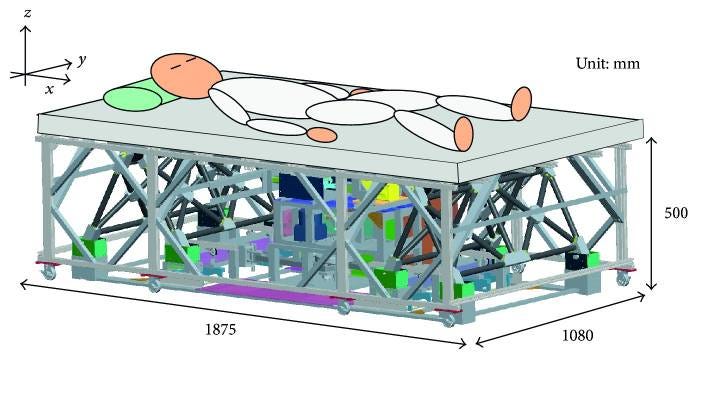
Their experiment tested naps of ten healthy young men at 0.5 Hz, which resulted in one gentle cycle every two seconds.
What the researchers changed in the experiment was how far the bed moved on each cycle, from a 2.4 mm shift you can barely notice, up to a 7.5 mm one you would clearly feel.
Without any vibration/oscillation, the men took on average 14.7 minutes to fall asleep.
With the smallest 2.4 mm movement, that dropped to around 10 minutes.
The sweet spot is a vibration you almost cannot feel. This broadly aligns with Neera’s approach to nighttime use program, where the intensity is reduced to remain gentle and unobtrusive.
Then there is one more study that comes closest to Neera's two-frequency trick.
A team at Brigham Young University placed four vibration generators under the corners of a bed and tried two settings on 14 people with mild to moderate insomnia in 2021.
In the first, all four corners vibrated at 26.75 Hz.
In the second, the top of the bed ran at 26.5 Hz and the bottom at 27 Hz, so the two waves drifted in and out of phase with each other and produced a slow travelling wave at 0.5 Hz, the "beat frequency."
The result of the beat frequency is that the person on the bed feels it as a gentle wave rolling head to toe, which stimulates both the skin and the vestibular system, sensory system located in the inner ear (remember the experiment with the rocking mice from the beginning of this article). And the result is a feeling a bit like being rocked.
That is the same basic superposition principle Igor described: combining two nearby frequencies to create a low-frequency beat pattern that can be experienced through the body.
As a result, the beat-frequency led to participants falling asleep in under five minutes versus about seven minutes for the control, and participants rated the 0.5Hz experience as more comfortable and easier to fall asleep with.
And What About Sound or Vibration at 40Hz?
This specific frequency is interesting because 40Hz is the gamma frequency associated with high-level cognition, memory consolidation and, we now believe, glymphatic activation.
The glymphatic system is the waste removal system for the brain.
As we age, and especially in Alzheimer’s, gamma oscillations weaken and become disorganized.
In Nina’s Notes #171, I covered a study published in PNAS on January 5th that found that playing sound at exactly 40Hz for one hour a day helped the brains of older rhesus monkeys flush out amyloid-beta, the sticky protein found in Alzheimer's disease brains.
After a week of 40Hz sound exposure, amyloid-beta levels in the cerebrospinal fluid increased by more than 200%.
What that means is that the amyloid-beta wasn’t accumulating in the brain tissue where it causes damage, it was showing up in the fluid draining away from the brain and the brain was actively expelling its toxic buildup.
And remarkably, those elevated CSF amyloid levels remained five weeks after the sound therapy ended.
While I didn’t ask the Neera team which frequencies played during the last cycle when I tested the bed, the “ramp back up toward alertness” cycle…perhaps it included 40hz.
This means they could potentially offer a glymphatic activation program at 40Hz vibration in the future, possible idea!
My Final Question For the Neera Team was Around Pain.
After my session on the Neera, I also asked the team if they considered studying reduction in pain from the Neera bed.
Vibration has been shown to reduce certain types of pain by more than 40%.
This is a great alternative to pain killers and opioids which are often the last available option for people in chronic pain.
What happens is that naturally occurring mechanisms help to blunt the severity of pain signals sent to the brain. Participants may be distracted from the pain, or simply experience pain relief from the vibration.
While this is not on the roadmap for Neera at the moment, this could be very compelling for people in chronic pain, or recovering from injury, as falling asleep can be difficult as pain can keep a person awake.
Finding a way to reduce the pain, plus the soothing feeling of rocking or vibration, can be very powerful for this group of people.
What I Am Taking Away
A slow rhythmic input, whether it is a rocking hammock, a moving car, a vibration you can barely feel, or a soft beat in your headphones, seems to help the brain find the rhythm of sleep.
Louder and stronger seems to work against you.
And the closer the input is timed to what your brain is already doing, the better it works.
While we wait for the Neera to reach our homes (reserve one here), we will just have to experiment with sounds…or a fully rocking bed, to fall asleep faster.
📚 Book of the Week

The Calamity Club by Kathryn Stockett
Rating: ★★★★★
Ok, the first 15% of this book…I was bored. AND THEN, everything shifted and I couldn’t put it down.
I was reading until 1AM most nights last week.
The story starts with Meg, whose mother disappears one night before Christmas, and she is taken to an orphanage in rural Mississippi. In a second storyline, a young woman named Birdie, and her family are struggling and she goes to visit her sister, who had married into a wealthy family, to ask for money. Birdie arrives and is asked to volunteer at the orphanage, where she meets Meg and becomes determined to help her.
The rest of the story captivated me more than any book I’ve read in recent years. If I could give this book six stars, I would.
The Calamity Club is written by the author of The Help.
💻 Join My 30-Day Claude Challenge
This is for my Ladies Who Claude. Ladies who are entrepreneurs, freelancers, and small business owners.
We are going to Master Claude Code in 30 days for business women.
Topics include how to automate replies so your inbox is already handled before you wake up, making websites, creating a social media “command center” to manage posting across social channels, and automating invoicing.
In the Challenge you will get:
Daily video lessons delivered to your email
Real Use Cases, real builds, and tips from over 300+ hours of coding with Claude
Once a week live calls with me
Access to a community of women building together
You don’t need to be savvy with Claude. I’ll get you all on the same level.
If you are already using Cowork and Code, great! You will find the use cases, and live-builds truly valuable.
We start September 21.
And I only have 3 spots left.
🗣️ Looking for the Nina’s Notes Podcast?
You can find the Nina’s Notes podcast on 🔴YouTube 🟢Spotify, 🟣Apple Podcasts, 🟠Substack Podcasts where I interview entrepreneurs and have an archive of 100+ voiceovers of previous Nina’s Notes.
Edited by Wright Time Publishing