


Hey friends,
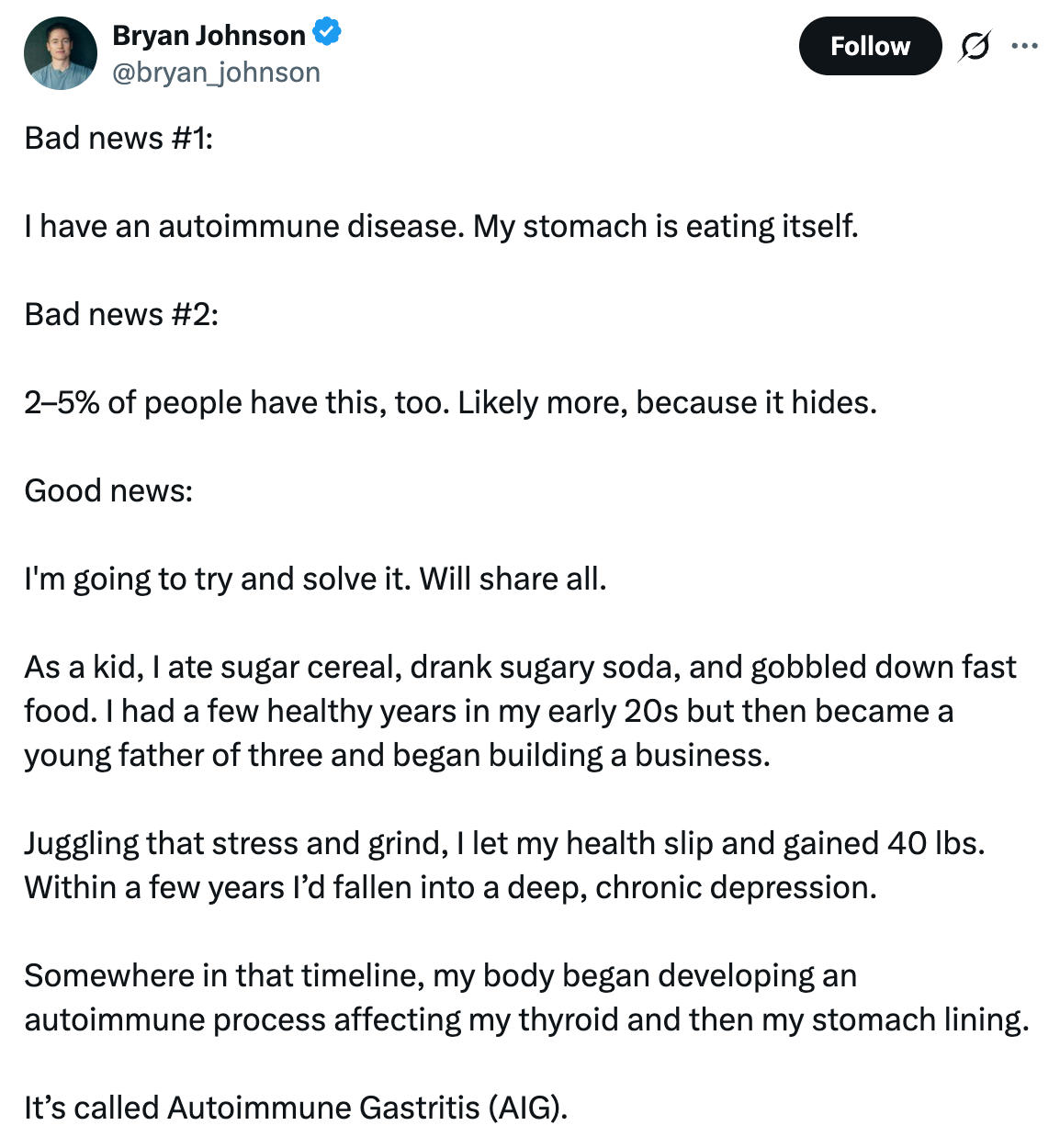
A few months ago, longevity influencer Bryan Johnson, announced on X that he has a chronic autoimmune disease.
He started the “Don’t Die” movement, truly believing he could live forever. On his socials he would post bold claims about the number of nighttime erections and boast about his impeccable sleep quality and organ health.
Yet, somehow he missed finding a chronic disease.
What does this say about measurements and healthcare?
That’s what today’s newsletter is all about.
Let’s go.
Cheers,
Nina
💬 In this note:
🏥 Bryan Johnson Has A Chronic Illness
📚 Lula Dean’s Little Library of Banned Books
⚡️ Sleepscroll
#194: 🏥 Bryan Johnson Has A Chronic Illness

Last month Bryan Johnson announced on X that he has autoimmune gastritis (AIG), with the clickbait title “My stomach is eating itself.”
Ok Bryan…drama.
In that same post, he detailed the trial-and-error of testing and missing the true diagnosis over several years.
He’s enraged he didn’t find it sooner.
The earliest signal was his low ferritin, a measure of the body’s stored iron.
Bryan had changed his diet and tried oral iron supplements, but his ferritin stayed low.
And according to his reports, it stayed low for about a decade.
Once his team finally decided to chase after the root cause of the low ferritin, they turned to antibody blood testing, an upper endoscopy and five stomach biopsies from three regions of his stomach.
That rigorous testing is what finally produced the diagnosis.
Why A Decade Of Data Didn’t Say Anything
Ferritin measures stored iron, while hemoglobin (the common measurement for iron on routine blood tests) measures circulating iron.
When your iron stores run low, your body protects hemoglobin first. It drains the reserves to keep your blood count looking normal.
It is possible to be completely iron depleted with a perfectly normal CBC.
Hemoglobin is the lagging indicator, and ferritin is the leading one.
Standard care is built around the lagging indicator, hemoglobin. Because that is how anemia is defined and diagnosed.
Important note: Ferritin is not commonly measured on blood tests, even on my last blood panel here in Portugal, they didn’t include it, my doctor’s only measured hemoglobin. Ask your doctor to include ferritin on your blood tests, especially if you are a menstruating woman.
Bryan wasn’t anemic, so the low ferritin kept getting ignored.
Secondly, there is another problem.
The bottom of the ferritin reference range marks depletion, not sufficiency.
That number is derived from a population that includes plenty of iron deficient people.
Sitting above the bottom of the range reads as “ok” on a lab report, instead of “your iron tank is empty” in your body.
The real problem was the non-response.
His doctors recommended higher iron diets, even iron infusions.
But the ferritin didn’t move into the normal range.
His doctor thought that it was the dose. They thought, ok we will just give Bryan more iron.
They switched the formula and tried to add other supplements. But that loop can run for years, as you want to supplement for a given period of time before retesting.
But an intervention (like IV iron infusions) that should work and doesn’t is diagnostic information.
Iron that goes in and doesn’t stick means you're either losing it, or you can’t absorb it.
Also, Bryan already had an autoimmune thyroid disease.
Autoimmune gastritis and autoimmune thyroiditis cluster together often enough to have a name, thyrogastric syndrome.
Low iron blunts the conversion of the thyroid hormone into its active form, and low thyroid function impairs how the body handles iron.
Each one makes the other harder to fix.
And this information was sitting in Bryan’s medical records the whole time.
The data was there the whole time!
He, and his care team, missed the interpretation.
I can only think about all of the women with immune-mediated conditions who struggled for decades to get a diagnosis (ahem…endometreosis), without a private care team, without unlimited testing panels, without anyone willing to keep digging to find a diagnosis.
Endometriosis takes an average of 7 to 10 years to diagnosis.
Most of those women never get their endoscopy equivalent.
What does this mean about testing in the longevity space?
The thing is….Bryan did catch his diagnosis early.
Even if he doesn't believe it.
His biopsies showed atrophy confined to the acid-producing lining, with the rest of the stomach spared.
Most people get diagnosed years later, when they are anemic and have B12-related neuropathy.
He cited a study where roughly 18% of people with precancerous gastric lesions carried the autoantibodies and only about 1% had ever been diagnosed.
So the frequent testing did work, eventually.
Just not in the way the longevity narrative promises.
It didn't prevent him from ever getting autoimmune gastritis.
What it did produce was a decade of anomalies that finally escalated to actual clinical medicine.
Even the most measured man still needed an endoscopy, five biopsies from three regions of the stomach, and antibody testing.
Testing generates hypotheses.
The value of a testing panel is entirely determined by whether anyone is willing to chase the outlier that doesn't fit.
And the longevity model is built to optimize markers that respond to levers, not to investigate the one that refuses to.
💻 Join My 30-Day Claude Challenge
This is for my Ladies Who Claude. Ladies who are entrepreneurs, freelancers, and small business owners.
We are going to Build Your Client Machine in 30 days.
That means we will automate prospecting leads, automate outreach, generate proposals and chase invoices, all with Claude.
In the Challenge you will get:
Daily video lessons delivered to your email
Real Use Cases, real builds, and tips from over 300+ hours of coding with Claude
Once a week live calls with me
Access to a community of women building together
You don’t need to be savvy with Claude. I’ll get you all on the same level.
If you are advanced, not to worry. You will find the use cases, and real builds truly valuable.
We start September 7.
Apply here to join.
📚 Book of the Week

Lula Dean’s Little Library of Banned Books by Kirsten Miller
Rating: ★★★★★
In the small town of Troy, Georgia, a local woman born and raised in Troy, Lula Dean, has taken on the mission of ridding the town of any inappropriate books (which she may or may not have ever read herself).
Once all the inappropriate books are removed from the library, she sets up her own little lending library outside her house full of appropriate books.
One day, someone takes the dust jackets off the books in Lula’s library, and hides the “banned” books underneath - literary classics, gay romances, Black history, witchy spell books and more. The neighbors who borrow these books find their mindset shifting and lives changed.
I really enjoyed this book because it allows you to analyze tough topics like racism, prejudice, sexual assault and other heavy issues through a more light hearted storyline.
⚡️ Check This Out

Doomscrolling, that is nothing at all about doom and gloom.
It’s actually designed to put you to sleep.
A starry night, where you can scroll and scroll and scroll.
Double-tap to light up stars, and count sheep.
Give it a try the next time you find yourself endlessly scrolling before bed.
🗣️ Looking for the Nina’s Notes Podcast?
You can find the Nina’s Notes podcast on 🔴YouTube 🟢Spotify, 🟣Apple Podcasts, 🟠Substack Podcasts where I interview entrepreneurs and have an archive of 100+ voiceovers of previous Nina’s Notes.
Edited by Wright Time Publishing