


Hey Friends,
On a roadtrip to Nazaré back in December, yes, to watch humans voluntarily surf 30-metre waves, which is its own kind of madness, a friend turned to me and asked something that’s been stuck in my head ever since.
“Should we migrate like birds and chase the sun, or should we go with the seasons? Is it possible that our bodies are actually optimal in the habitat where we were born?”
I grew up in Las Vegas. 360 days of sun a year. Desert heat. A sun that is trying to kill you.
And every winter when I lived in Berlin, I’ve had the same quiet breakdown when November hits. The light disappears, my mood tanks, and I spend three months wondering why anyone voluntarily lives in the dark.
So yes. Guilty. I chase the sun. (I wrote this from Australia. No regrets.)
But is this just a personal preference, or is there something deeper going on biologically?
Something that predates me, my choices, even my lifetime?
That’s what I wanted to find out.
💬 In this note:
☀️ Chasing the Sun
📚 Being You
⚡️ Do Your Parents Know What You Do For Work?
#170: ☀️ Chasing the Sun
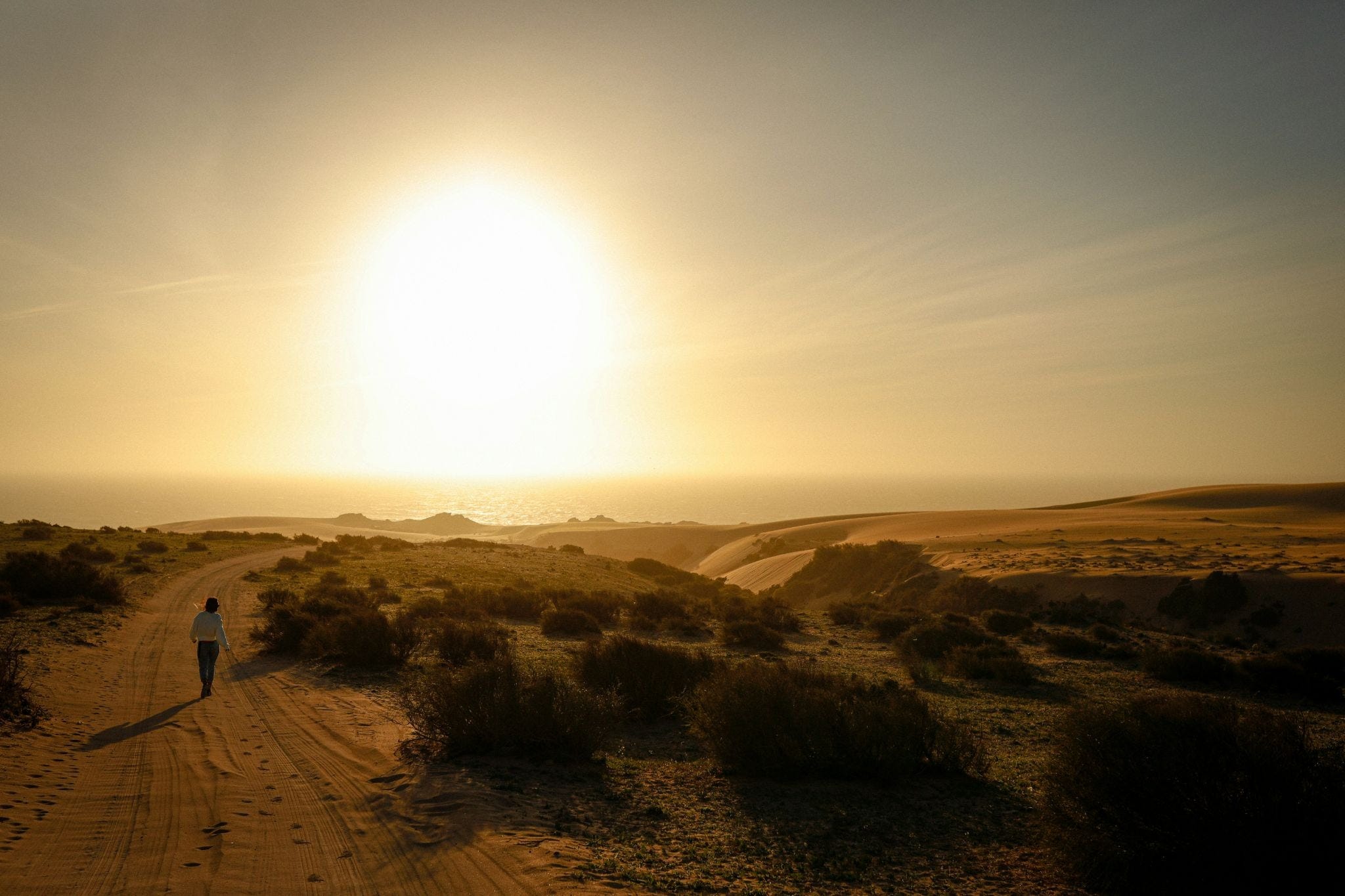
Photo by Florian D. Bazac on Unsplash
Your body has a blueprint
Humans have spent tens of thousands of years adapting to the specific environments their ancestors called home, extreme cold, high altitude, low light, desert heat.
That creates what you might call a biological blueprint.
Your native habitat is often the environment where your body experiences the least friction, because it’s the one your genes were shaped for.
Take high-altitude populations in the Andes or Himalayas. Their hearts and lungs are genetically adapted for thin air. Move them to sea level and something might feel... off. Heavy. Wrong.
The same principle applies to temperature and light.
Our genes for thermogenesis, the way our bodies generate heat, were sculpted over 30,000 years by the climates our ancestors inhabited.
Populations from colder climates have genetic variations that enhance brown adipose tissue (BAT) function, which plays a key role in metabolism and energy balance.
If someone genetically optimised for cold moves to a tropical climate, it can create a metabolic mismatch, increasing risks for obesity and diabetes, because the body is programmed to store energy in a way that no longer matches its environment.
Unfortunately, your genes don’t update when you buy a plane ticket.
So what are snowbirds actually doing to their biology?
Quite a lot of good things, it turns out.
Longer daylight hours strengthen your circadian signals. Better alertness during the day, deeper sleep at night.
In winter, lower solar angle means less UV-B radiation reaching your skin, and less vitamin D production as a result.
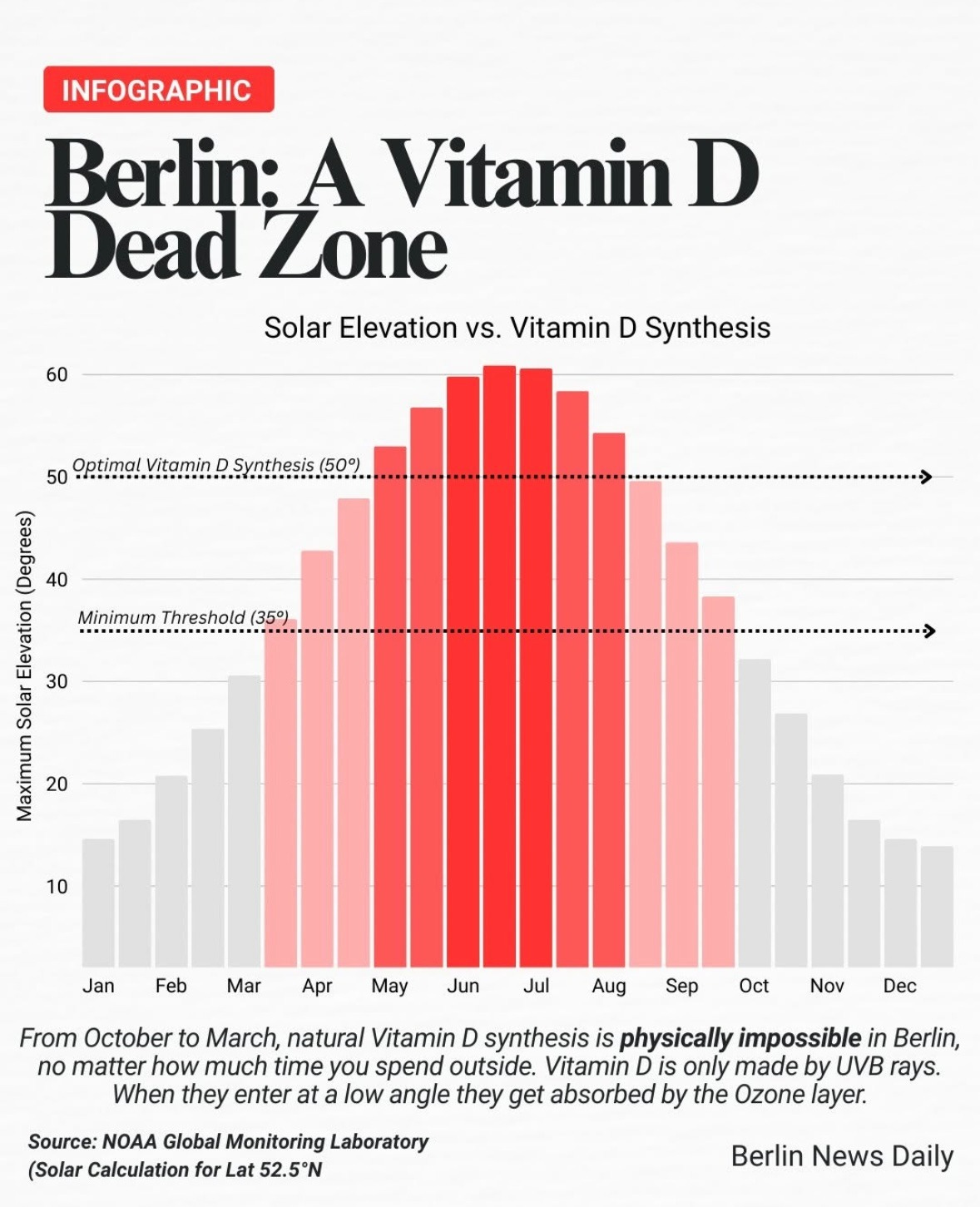
In Berlin in the winter, you synthesize 0% vitamin D.
The figure above plots the sun’s elevation for Berlin for every month of the year.
The data reveals a hard truth that Berlin is a Vitamin D dead zone in the winter.
When the sun sits low on the horizon, like in winter,the sun’s rays travel a long diagonal path. The light travels through a thicker part of the ozone which absorbs 99.9% of UVB radiation.
You see visible light, of course, but the beneficial biological signals are filtered out. No matter how much time you spend outside in December (or even March) in Berlin, your Vitamin D synthesis is effectively 0.
Vitamin D deficiency weakens your immune system. And the expanded darkness of northern winters is linked to increased inflammation, fatigue, and higher risk of seasonal affective disorder (SAD).
Chasing the sun doesn’t just feel good.
For many people (like me!), it genuinely prevents these seasonal declines.
Want to read the rest?
Upgrade to paid to get the full breakdown including: why constant migration might actually hurt your biology, the concept of “circadian load,” how to figure out if you’re fighting your own genetics, and tools to track your circadian alignment.