


Happy New Year!
Big news here! I’m launched a brand new podcast with Phil Newman where we explore the ideas, science, and human stories shaping how we can live longer, healthier lives.
Longevity.Technology UNLOCKED launched on Monday, Jan 5th with twice-weekly episodes featuring scientists, innovators & investors shaping healthspan research.
Our first episodes are already live!
Our first episode was 𝘎𝘓𝘗-1𝘴 – 𝘚𝘩𝘰𝘶𝘭𝘥 𝘞𝘦 𝘈𝘭𝘭 𝘉𝘦 𝘛𝘢𝘬𝘪𝘯𝘨 𝘛𝘩𝘦𝘮? with Dr. Eric Verdin, CEO and President of the Buck Institute for Research on Aging & Dr. Prof Jens Juul Holst, professor of Medical Physiology in the Department of Biomedical Sciences at the University of Copenhagen, who first discovered and described the GLP-1 hormone.
Episode 2, we covered the latest Longevity news from the end of 2025 and beginning of 2026 - we covered AI Drugs, Autophagy and Blue Zones.
Episode 3 dropped on Monday, January 12th where we sat down with Formula E racecar driver Lucas DeGrassi!
Subscribe on Spotify, Apple Podcasts, or YouTube.
So now, you get 3x a week content from me, with the regular Nina’s Notes publishing every Wednesday.
I hope you enjoy all of it! Please like, comment and let me know how you feel about the new podcast.
Cheers,
Nina
P.S I’ve also recorded this episode, and it’s over on my Nina’s Notes YouTube channel.
💬 In this note:
🤩 The Estrogen-ADHD Connection That No One Talks About
📚 The Secret of Secrets
⚡️ 2025 Word of the Year
🔮 Cool Job Opportunities
#164: 🤩 The Estrogen-ADHD Connection That No One Talks About
Before I left on my trip home for the holidays, I was having drinks with a group of girlfriends in Lisbon, and one mentioned that she felt like her ADHD symptoms are more severe because she has high estrogen.
Then, at a talk I gave about psychedelics and longevity, I mentioned a connection between estrogen and the serotonin (5HT2A) receptor. An audience member asked me if it’s also possible that estrogen and ADHD have a connection.
I didn’t know, so I dug into the scientific papers and I’m here to report back what I found.
Ladies, we were right - Estrogen and ADHD have a connection.
And, as we already know, ADHD in women is under-researched and gets way less attention than it deserves.
Starting with the fact that girls and women are far less likely to be diagnosed with ADHD compared to boys and men.
It’s because our symptoms show up differently.
Why ADHD Gets Missed in Women
There are many reasons why ADHD may not be recognized in girls and women.
One reason clinicians ‘miss’ diagnosing ADHD in women, is due to it being more commonly associated with boys and men. Ugh.
Second, while boys with ADHD may be bouncing off the walls, women’s ADHD symptoms tend to be more “internal.”
Women are not necessarily hyperactive, we may be overwhelmed, anxious, battling brain fog and low mood.
Since women’s symptoms are less external, the struggles and problems we face are not as obvious to others.
This can mean that we also deal with feelings of shame, inadequacy and isolation instead of getting the support we need.
Many women therefore don’t get diagnosed until their late 30s, 40s or even later, often when symptoms suddenly worsen during perimenopause or menopause.
Even more frustrating is that mood-related symptoms are common indicators of ADHD in women, but they are often misdiagnosed as depression or anxiety disorders when ADHD is the root cause.
How Do Hormones Affect ADHD?
Women with ADHD often report that hormonal fluctuations can have a big impact on their ADHD symptoms.
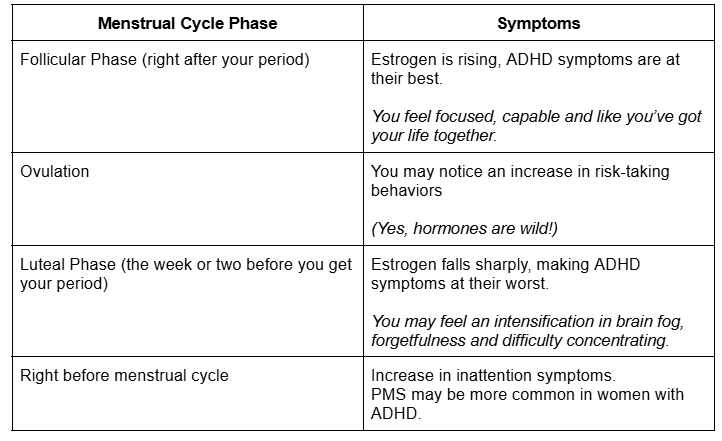
In menstruating women with ADHD, symptoms are described as below:
Women with ADHD are also more likely to experience severe PMS and premenstrual dysphoric disorder (PMDD).
PMDD affects ~5% of menstruating people with severe mood swings, depression, anxiety & physical symptoms in the luteal phase (week before period).
It’s not “just hormones,” it’s a legit disorder involving abnormal brain response to normal hormone changes that seriously impacts quality of life.
When you combine PMDD and ADHD, symptoms become even more pronounced.
ADHD During Pregnancy
Pregnancy brings massive hormone level changes.
For many women with ADHD, symptoms get worse during the first trimester.
Unfortunately, there is limited research regarding medication use and ADHD during pregnancy.
A small 2022 study, found a difference in women regarding their moods and family functioning, between those who discontinued medication and those who continued taking it.
Those who continued taking their medication during pregnancy had better mood and family functioning compared to those that stopped taking their medication during pregnancy.
Also this study showed that we need more research here, badly.
Perimenopause, Menopause and ADHD - A Hormone Hurricane...if you will
In mid-life, women start to experience perimenopause. This is the transitional period into menopause, which can last up to 10 years.
During this time, estrogen levels begin declining, and menstruation becomes more irregular.
Perimenopause lasts on average for four years until menopause, defined as 12 consecutive months without a period.
Here’s why it matters for ADHD - Estrogen isn’t just a reproductive hormone, it plays a crucial role in cognitive function.
Estrogen helps thinking skills, concentration and attention.
It promotes the release of serotonin (which regulates mood) and dopamine (which plays a key role in executive functioning).
Estrogen also helps the production of dopamine and decreases the amount that’s broken down in the body.
This is important as having ADHD means you already have dysregulation in your dopamine production.
So when estrogen declines during perimenopause, ADHD symptoms can get significantly worse.
This was confirmed in a 2021 study which found that decreasing levels of estrogen and progesterone during perimenopause can cause ADHD symptoms to become more severe.
Russell Barkley, Ph.D said “Women who weren’t necessarily ADHD previously, or were able to cope with elevated symptoms that may not have been in the clinical range, now found themselves fully, clinically ADHD as they approach mid- to late life.”
Add in the symptoms of menopause, like hot flashes and brain fog, and you’ve got a recipe for serious cognitive challenges. Especially if you’re already dealing with ADHD-related focus and attention issues.
During perimenopause and menopause, estrogen therapy is sometimes prescribed to manage menopause symptoms.
Estrogen therapy may also help manage newly worsened ADHD symptoms, however estrogen is not prescribed for ADHD alone.
Keep a Symptom Journal To Track Your Patterns
For women with ADHD, hormonal changes can impact your symptoms.
Understanding how your hormones change can go a long way in managing symptoms and addressing needs over time.
If you feel that puberty, pregnancy, your cycle, or perimenopause/menopause are affecting your ADHD symptoms, you can keep a symptom journal - a daily record of the symptoms you experience, along with daily habits, and medications taken that may affect these symptoms.
How to Track:
Dates and times when you notice increased symptoms
When you take medications
Mood Changes
Sleep length and quality
What and when you eat and drink
Where you are in your cycle
Any other symptoms, even if they seem unrelated
Apps like Clue or Flo allow you to track period-related symptoms
Your symptom journal can help you see patterns and triggers. It can be particularly helpful when talking to your doctor. Your doctor can help you to manage new or exacerbated symptoms while considering your individual needs.
Understanding the connection between hormones and ADHD is crucial for women’s health.
If you’re experiencing worsening symptoms during certain times in your cycle, pregnancy or perimenopause, firstly, know that you are not alone and there are strategies that can help.
Talk to your healthcare provider about your symptoms and what you are tracking. The more we understand about these patterns, the better we can advocate for ourselves and get the support we need.
Want to Improve Your Health and Wellness in 2026?
My guidebooks translate the latest longevity science into practical, actionable strategies you can implement today.
I have guidebooks for optimizing your sleep, breathwork, understanding age-fighting drugs, exercise protocols, and so much more.
My Men’s Health After 40 Guidebook is a best-seller!
Each guide is packed with evidence-based insights.
Start with the free Breath for Longevity guidebook, or grab the Complete Longevity Library bundle for the full toolkit.
📚 Book of the Week
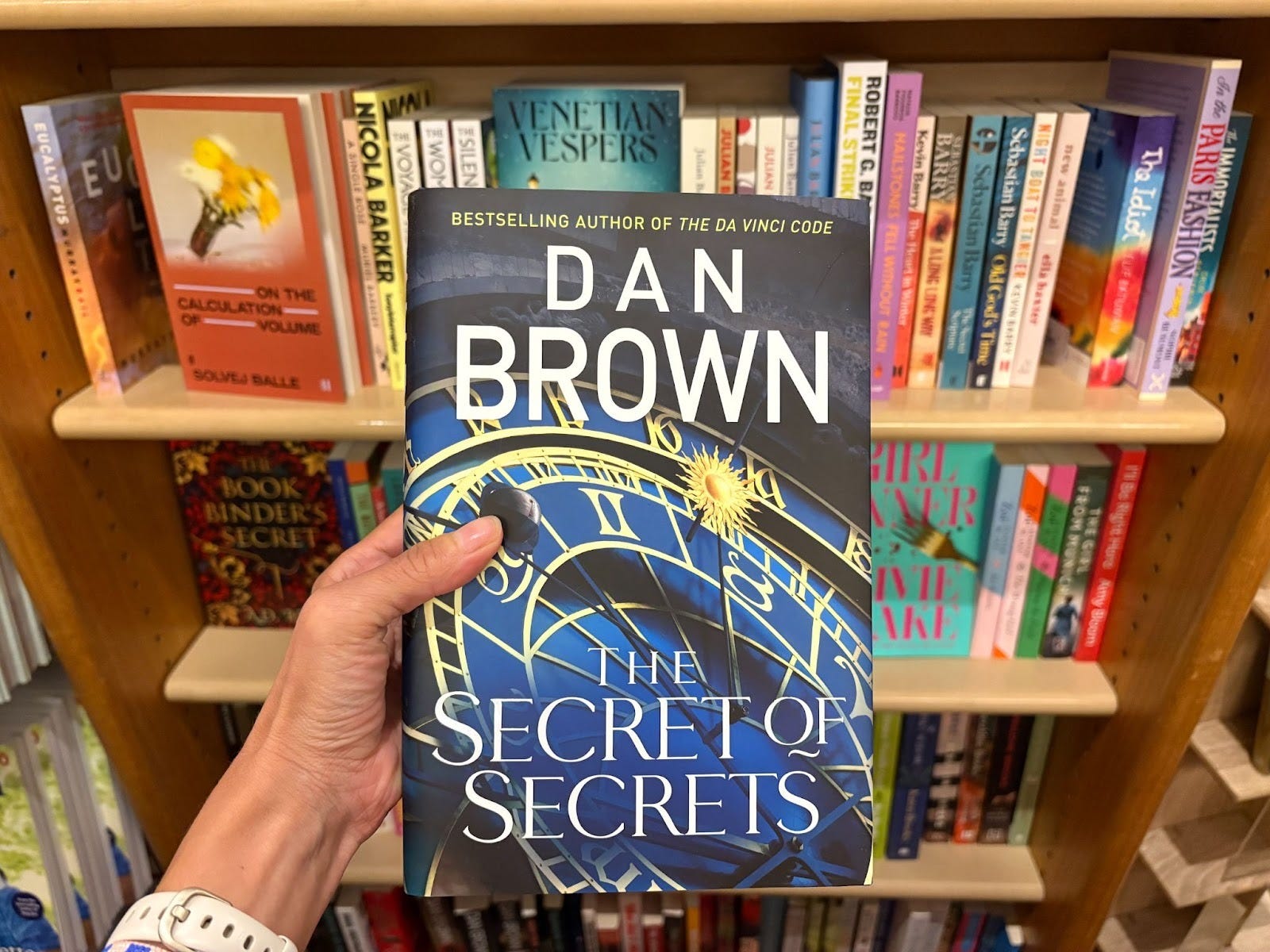
The Secret of Secrets by Dan Brown
Rating: ★★★★★
Judge me as you wish, but I do enjoy a Dan Brown novel.
Look, I know what you’re thinking. Dan Brown? Really? But hear me out.
After reading several of his books, I’ll admit the formula has become predictable. The twists don’t hit quite the same way they did when I first read Angels and Demons or The Da Vinci Code.
But here’s what I still appreciate, the man does his research. These books are page-turners for a reason.
The Secret of Secrets is a novel about consciousness and explores the theories of local and nonlocal consciousness.
For those unfamiliar with the theories, local consciousness is the traditional view that consciousness is generated entirely by your brain, confined to your physical body. Nonlocal consciousness, on the other hand, suggests that consciousness might extend beyond the brain, that it could be something we access rather than something we produce.
In classic Dan Brown fashion, he is writing with the zeitgeist.
Consciousness research is having a moment right now. We’re in the middle of a psychedelic renaissance, and researchers are actively exploring how psychedelics might provide insights into the nature of consciousness itself.
These aren’t fringe questions anymore, they’re being asked in legitimate research institutions.
Dan Brown mentions that all the research, organizations, and researchers named in the book are real people.
And it’s true.
I found myself grinning as I recognized names of researchers I follow and reference when writing articles for this newsletter. Seeing them woven into a thriller novel felt like two worlds colliding in the best way.
If you’re interested in consciousness research, or just enjoy a well-researched thriller that makes you think about big questions, this is worth picking up.
Want To Go Beyond the Newsletter?
I mentor founders and ambitious professionals who want to build resilient minds and companies using evidence-based tools from neuroscience and longevity science.
Click here to learn more about private mentorship and upcoming group sessions.
⚡️ Check This Out
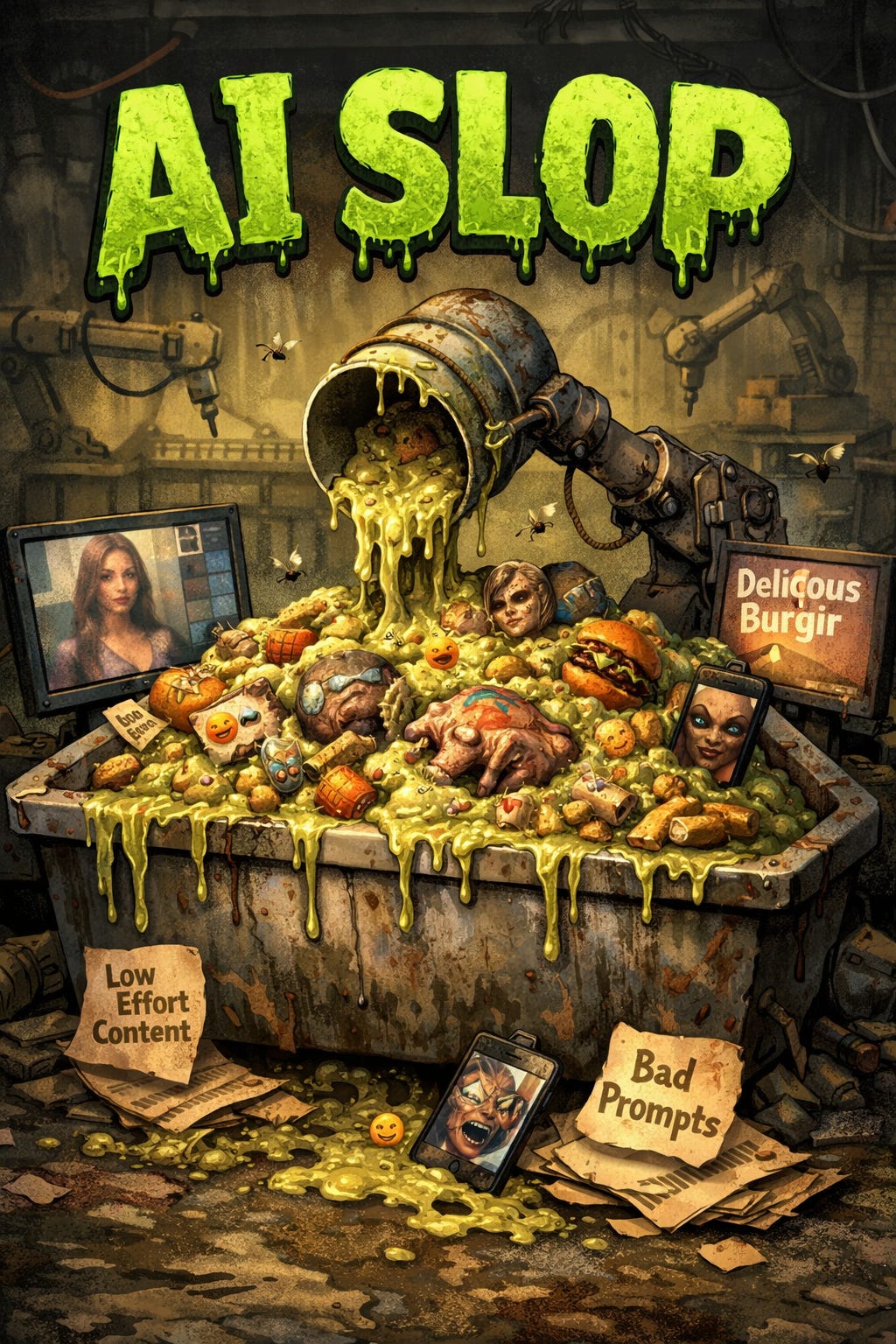
The 2025 word of the year is in, and it’s… “slop.”
Yep. AI slop.
And….we all know exactly why.
Merriam-Webster defined “slop” as “digital content of low quality” typically made with AI. The Macquarie Dictionary went even more specific and chose “AI slop” as its word of the year.
If you’ve been online at all this year, you’ve seen it. Those terrible generic articles that sound almost right but feel empty.
The LinkedIn posts that read like a robot trying to sound inspirational. The blog content that technically answers your question but leaves you feeling unsatisfied.
2025 was absolutely the year we hit peak AI slop, when the internet got flooded with content created for the sake of content, with no real human insight, expertise, or care behind it.
This word of the year is a great reminder that in a world drowning in AI-generated content, human expertise and authentic voice matter more than ever.
Which is exactly why I’m committed to keeping Nina’s Notes thoroughly researched, science-backed, and actually written by a human who cares about this stuff. No slop here.
🔮 Cool Job Opportunities
Are you hiring? Want to share your job with Nina’s Notes? Send me an email: hi@ninasnotes.xyz
🗣️ Looking for the Nina’s Notes Podcast?
It’s now available on 🔴YouTube!
You can also find the Nina’s Notes podcast as always on 🟢 Spotify, 🟣 Apple Podcasts, 🟠 Substack Podcasts
On the Nina’s Notes Podcast I interview entrepreneurs who are building products based on the science that I write about in the Nina’s Notes Newsletter.
You’ll also find voice overs of all the weekly Nina’s Notes.
Thanks for reading Nina’s Notes #164. If you like this newsletter, click the share button and send it to a friend.
Edited by Wright Time Publishing